Wednesday, September 15, 2010
The Rockaways
One of the more surprising aspects of many New Yorker's lives is the presence of an active, old, and enduring beach culture. Too often our visitors hit the big tourist spots in Manhattan, maybe take a ferry ride or two out to the see sites, and just assume we all live on that island.
But the truth is, the boroughs of Queens and Brooklyn are part of the larger land mass which forms Long Island. The Rockaways consists of a series of towns on a smaller spit off this island, between Jamaica Bay and the Atlantic Ocean. When you swim (or surf, or kayak) the Rockaways, you are in the Atlantic Ocean. And it's expanse is as wide and vast as that ocean.
I found the most interesting dichotomy to be this difference between an obvious beach culture, and the neighborhood right after the boardwalk, because many parts of the Rockaways border projects and ghettos. It's quite a shock between the two, a stark contrast in feelings and realities, given the beach and all its' connotations. One typically associates "beach" with resorts and vacations hot spots, not a depressed local economy. It is in this sad reality which parts of the Rockaways exist. There is no reason why these beautiful beaches shouldn't attract all kinds of visitors and New Yorkers.
It is my firm hope that after the revitalization project in Coney Island, we all turn our attention back to this place, and help smooth out the contrasts between the boardwalk and the bordering towns. This is New York, and we all deserve to comfortably swim it's shores, in an ocean as beautiful as the Atlantic.
Sunday, September 12, 2010
Brooklyn Book Festival
A soggy day for this annual event did not stop the flannel-clad hipsterati of literary Brooklyn from supporting their bibliophilism.
Remembrance
I've always loved the simplicity of two pure, brilliantly bright white lights stretching high up into the clouds. It's beautiful, without being showy or overwrought; spiritual, meditative, and somehow, despite their size, quiet and gentle—a religious depiction of true faith, without hearkening to any particular one.
Whatever the outcome of all the recent construction, power struggles, and political gaming, I feel rest assured my fellow New Yorkers will always cherish this symbol of what remains our devotion to the ideals which this city has come to represent: liberty and justice for all. Displays like these, which mark the significant events that have come to shape the American character, serve as a reminder for us to hold onto all our beliefs and ideals even tighter.
Mourning is public. Grieving is private and personal. These represent both of those states to me.
Sunday, August 1, 2010
The Brooklyn Cyclones
Nothing says "Summer" to me like a baseball game. Add in Coney Island, a Nathan's foot long hot dog, Brooklyn Lager in a black can, the boardwalk, surf and sand, and you have one heck of a good time. A Cyclones game is the minor leagues at its' best; where you sit is irrelevant, because you can pretty much sit wherever you want, despite what your ticket says.
There's cheerleaders (!), enthusiastic high school girls who dance on top of the dugouts, the standard t-shirt guns, weird balloon mascots, free jersey night, Thursday nights everyone gets to run the bases, there's fireworks on Fridays, and a real crowd pleaser called King Henry.
Once you've had you fill (of food or the game), all you do is exit through a gate and walk out onto the boardwalk. I always end a game by wading into the water, just a little bit. Please feel free to steal my tradition :)
Wednesday, July 21, 2010
The Grand Tetons of Wyoming
| Mormon Row, in Grand Teton National Park. |
The "hole" in the name "Jackson Hole" was originally used to describe a valley, crude as that seems to us now. The Jackson Hole area is actually one big valley next to the Tetons, and they are grand, especially from the backs of our bikes, rented for a tour of the area. Go see it for yourself!
Wednesday, July 7, 2010
The American Bison of Lamar Valley
One of the more interesting facts we learned during our large family vacation (from resident wilderness expert and tour guide extraordinaire, Mike) was the mistake behind the word "buffalo", as it is so often used. Buffalo are the animals from Asia and Africa, while "bison" refers to the American species. It is still allowable in common usage, given the prevalence of the term buffalo in American folklore, like historic songs ("...where the buffalo roam..." ) and mythic stories about the Old West.
It's an overwhelming and emotionally powerful experience to see them in their natural environment; how completely they fit into this big sky landscape! Given the abundance of food for them in their valley home, bison have exploded in population recently, giving us a sense of the originally massive herds that covered the land back then. Settlers once thought the bison of "The American West" were inexhaustible.
But dwindle from over-hunting they did, until finally (in order to re-populate Yellowstone), biologists replenished the wild herd we now see from private stock held in ranches. Those animals were crossbred with the few wild bison left, in order to create the large herds of Yellowstone roaming free that we see today.
It is a breathtaking wildlife preserve, as our very own "American Serengeti": a natural paradise for us here on Earth.
Yellowstone National Park
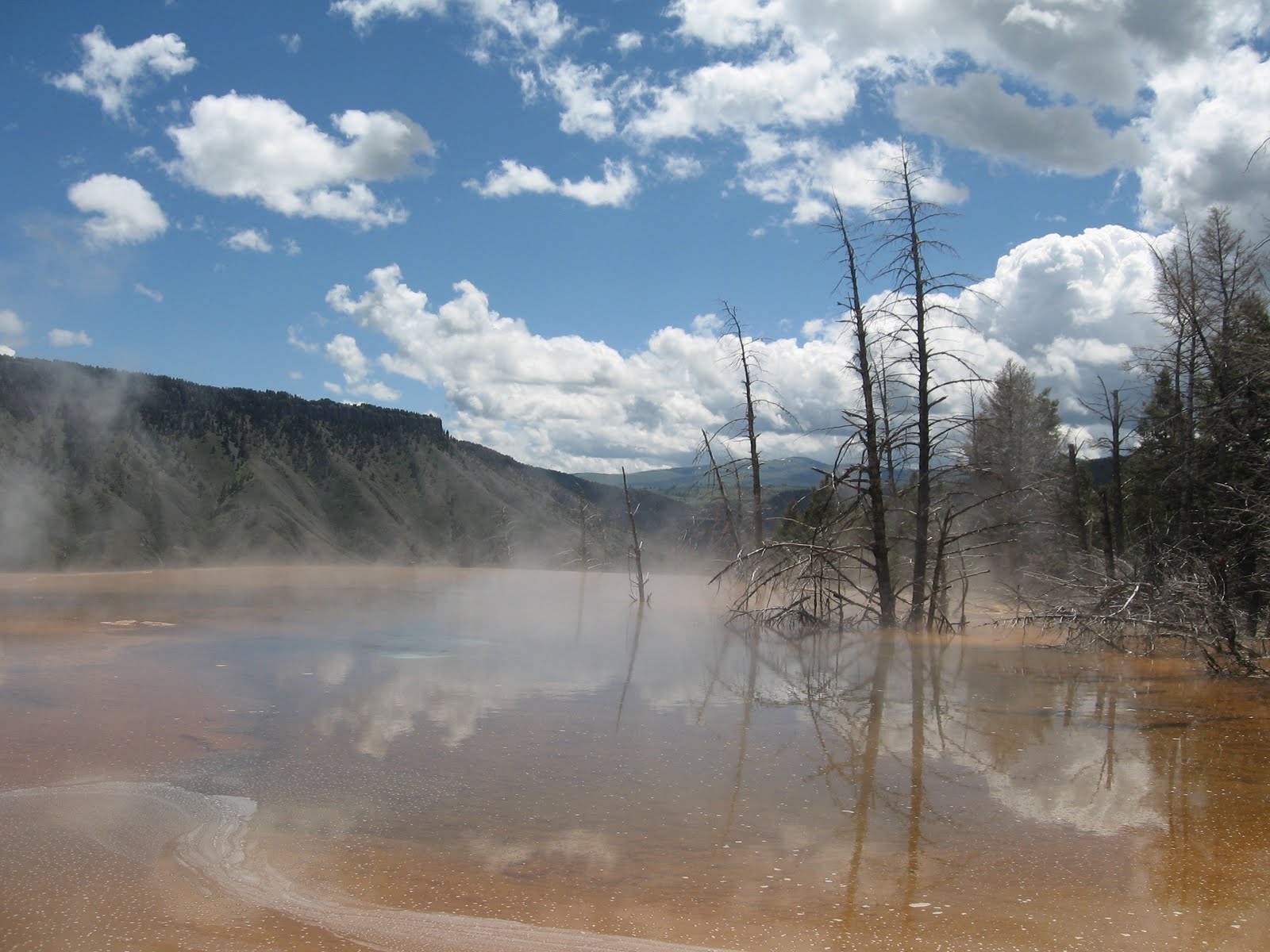
Geothermal features permeate the park by the thousands, to include: boiling springs, hot springs, both boiling streams and hot streams, mud pots, mud holes, geysers, thermals, cones—every facet of an active live volcano you can think of (besides the more well-known image of exploding lava), is in Yellowstone National Park.
You can easily see the instability of the earth's surface from a just casual walk around the park's most visited areas, especially at its delicate edges, because the landscape there changes and shifts all the time. New hot spots open, become dormant, or shrink and then widen very quickly, as a perfect example of how fast a landscape can alter. A wild and savage beauty, this is "The Great American West" at its finest. You have to see it.
Tuesday, May 11, 2010
"Siddhartha", revisited.
Siddhartha has always been the quintessential coming-of-age story for me, especially since I was a teenager the first time I read it. Having to re-design a book cover for it at the age of 40 was an incredible experience.
There was so much detail packed into every page, so much we all learn as we go about about living life, that as I re-read it, I kept nodding my head "yes" in agreement to almost every paragraph. It was richer to me than before, almost beyond belief.
How similar and timeless the human struggle for life and the pursuit of happiness is; something we as a species all share. It deserves to be the well-read classic it has become. Endurable. And such a slim volume, really, but that's all it has to be. It is a lot like life; short and sweet, with all its' highs and lows, it's all of it, and for that, it is perfect.
Looking to Roost
This shot was a total surprise for me. I was with a friend, walking through Prospect Park, who pointed out this bridge, and thought it's beautiful structure might be a good possibility for a photo.
It was only afterwards, as I was editing shots, that I noticed I had caught a perfect moment in time; a bird in flight with it's wings in a blur of motion.
There were lots of birds in a flurry of activity that day. It was one of those gloriously sunny and blooming days of spring; red-wing blackbirds, cardinals, jays, robins, and naturally to any cityscape, the ever-present pigeon, were everywhere. I think this is a red-wing blackbird.
As anyone who likes and practices photography knows (either professionally or as a hobby), "happy accidents" are always welcome.
Tuesday, April 13, 2010
Monday, April 12, 2010
Sunday, April 11, 2010
Sunday, March 28, 2010
Weird Science
My mom, in her lab coat at the New York City Department of Health, at 22, working on Tuberculosis research. When I was growing up, she kept this photo in her wallet, next to her favorite pictures of us kids. I used to love to flip through her wallet and listen to her reactions about the photos she kept.
When I last visited her, I asked about it. She directed me to an album, whose contents I always associated with just our family's baby pictures. She kept telling me to keep looking, and there it was, folded and worn, but so clearly her! Here was the perfect illustration to my story.
I had been telling a friend about my mom and her education, and her career as a young research technician, because she had been an even younger college student than I, a college freshman at 17. My mom graduated high school at the age of sixteen. I had always thought this photo was from her first job, in the Bronx, at The New York Botanical Gardens. But, no, this photo was not from that time period. She was only 20 years old at the Gardens, working on finding a cure for a certain strain of tomato fungus. There were only 3 Botany majors at Hunter College in the Bronx, my mom and one other engaged couple, who were going on to grad school, so when the Botanical Gardens called looking for a tech, she was the sole candidate for the job. Like most non-profit jobs, the pay was very low.
Later that same weekend, when we visited with other family, my aunt told me the truth behind her departure from the Botanical Gardens. Seems my mom had been on the outs with her supervisor, due to her late arrivals in the morning, a problem with which she has been noted for her whole life. She found new employment under the classic conditions of quitting just before being fired, another infamous family trait.
To my mom's recollection, my grandfather urged her to work for the city, because the pay and benefits were much higher. That point of view would certainly jibe with my family's history in New York, one of union jobs and wages, of chasing the American Dream with a security blanket, a stability city jobs were famous for, at least they were in my family—my grandfather worked for Con Edison his whole career. City jobs were the original Golden Tickets, guaranteeing safe passage to Middle Class respectability.
Perhaps it was under this cloud of mixed memories that caused my mom to be less enthused than I was over finding this image. But to me it provides validation and proof of a rare and remarkable time for my mother, who humbly played down the fact that she was a woman fully employed as a scientist in 1963 at 22, and already on her second job. I couldn't help but be incredibly moved at her youth, her focus, her lab coat—all the things which entranced me as a child. This is my mother, here, working. Astonishing.
I love how soft her face looks here, and how she told me for the first time this past weekend that she remembered it was the NYC Dept. of Health and NOT the Botanical Gardens, because she has on her engagement ring in the photo, so she must be 22, the age she got engaged. Even after all these years, and all these viewings, this image still reveals new details to me, as I look at it through the eyes of a 40 year old.
Words are not enough to express the pride I feel in her accomplishments, so I'll let my before and after retouches tell the story for you.
Monday, March 15, 2010
Delivery for Martha Stewart
Sunday, December 13, 2009
West Texas, VI: The Horse Whisperer


Another passion of my fathers'—horses and riding. He has taught many children to ride, in an arena behind the house. Part of his various volunteer activities include working with children from the juvenile system. While they learn to ride and handle all the gear, along with the care of horses, he talks to them, or lets them talk to him, or just lets them absorb the experience and its lessons.
This is one of his ways of giving back—letting kids know his story about growing up in the Bed-Sty section of Brooklyn and being raised by a single mother who worked as a nurses' assistant (that's my grandma in the photo), how he made it out through the Navy, his education through the G.I. Bill, working days while going to night school; doing all this while being a young father raising three babies in the projects of Queens, where my family started.
He lets his life story tell the tale of his success—through hard work and application, nothing is beyond ones' reach, and that there are no limits to how high one can achieve. If you can dream it, you can do it, but telling yourself you can is the first step.
West Texas, V

I love this shot of my dad, because the mesquite seem to bend under his will. For me, it symbolizes the strong connection he feels to his land; how the landowner and all he surveys fall under his responsibility.
He takes his caretaker duties seriously. No hunting is allowed on the land without his permission, and poachers will be prosecuted. As a result of over-hunting, (since it is so popular in these rural areas) the territory is patrolled often.
Wild animals are allowed to come and go through the property, with the exception of coyotes. They are vicious predators of newborn calves, and are overpopulated in these parts.
This is his Serengeti; a land of unique beauty.
West Texas, IV

After driving down into the ranch, we parked at the ranch house to release the cattle onto the land. Now they'll be able to roam free and graze. For the moms-to-be, it's also calving season.
I was trying to capture how the wispy clouds mimicked the shape of the tree branches, and in some small way, how bright the light is there, and how blue the sky. Once you've seen the brilliance and expanse of big sky country, it's hard to forget it.
West Texas, III
West Texas, II
After the cattle were branded, a trailer was attached to a pick-up for transportation to the ranch. I took this shot out the window of the passenger side. To me, this photo captures how rural it is in this part of the state, by defining the essence of the saying "down the road apiece"—when "apiece" may mean ten miles or more. You can certainly see that far because of the flatness of the landscape.
For some reason, whenever I look at these roads pics, they remind me of "Fear and Loathing in Las Vegas."
West Texas
Saturday, November 21, 2009
High Anxiety.

My publisher recently told me this is THE definitive book on this topic—the one book most highly recommended by mental health care professionals to their patients than any other.
MJF went on to say that it has sold over 1,000,000 copies for other publishers, and has already sold over 650,000 copies for us (hence the cover copy tag-line on the front cover of our edition). Not too shabby for an edition retailing for $12.98, which is actually a "posh" price point for us!
This is a refresher reprinting off our backlist because the older jacket started looking dated. The design mission was fairly simple to meet: clean, emphatic, authoritative without looking stale or stodgy, modern, crisp, stand-out through boldness of colors. We had to avoid imagery since the range of phobias and disorders covered within are too vast to be placed comfortably on a cover.
Stickin' it to "The Man".

Ah, what list of ours would be complete without a selection from Disinformation Books. A true counter-culture imprint, they consistently confront and question commonly held misperceptions propagated through various media outlets, one inaccurate factoid at a time.
They make the old punk-rocker in me sing. Off-key, naturally.
The Day You Were Born, Fall 2009 list.

Interesting in the sense that I was combating commonly held stereotypes regarding astrology books. There exists in the public consciousness a distrust (or lack of seriousness) in daily horoscopes, a belief I share in varying degrees as well. So, my mission was to try and create a classy, seemingly expert tone to the book. I did this by using actual natal charts as the background art, used by professional astrologers who use a complex system of birth times and planetary alignments, and then a horoscope icon wheel as the centerpiece, which is the more identifiable symbol for horoscopes.
The center wheel is glossy—we used what's called a "faux" spot lam process, which takes a gloss jacket and then, after creating a mask, hits the outlying areas with a matte varnish. It's cheaper than using real spot gloss. That's the real challenge of bargain books; how to replicate and compete with luxury hardcover editions with 1/4 of their budget.
"Working", by Studs Terkel.

Second in a series after our 1st Studs Turkel edition "The 'Good' War". For this edition, my challenge was to find an image evocative of the concept of work, without harkening to the specifics of race, class, ethnicity, or social strata, since the book covers an enormously diverse range of voices from professions of all types.
So, I chose the daily commute as a take-off point, something every worker has to contend with in one form or another. My hidden fun built-in for readers is the spine detail: I wanted a subconscious connection between the Communist worker symbol of the hammer and sickle.

Another cool tie-in: Harvey Pekar wrote a graphic novel version of "Working", who I got to see speak recently at a Brooklyn comic book convention called King Con.
Subscribe to:
Posts (Atom)