Friday, September 16, 2016

Around the World


https://en.m.wikipedia.org/wiki/Around_the_World_in_Eighty_Days 


Parties at Oneonta became our go-to creative outlet for lifting our spirits and casting off the sometimes extreme pressures we were under, as working class kids from New York. When I mentioned to my father recently that I can write "lowbrow" at times in a colloquial dialect that is unique to this area, and to also mean that I can be at every level of work, he reddened and barked a sudden harsh laugh at me, baring his top row of dentures. "Hah! Yeah, you're 'lowbrow'!", as if I had suddenly forgotten who I am and where I was, which I hadn't. I have plenty of reminders. 

I don't have the luxury of checking out from my life, no matter how bad it can sometimes be, because such is the nature of living. Suffice to say, unlike the hangers-on to our hip scene, I really wanted to learn, and anything that jeopardized that went out the window. I couldn't afford to not be present during my own education, happily deferring it to the hands of others, like so many other spoiled suburban kids. I was born in the projects of Queens to an Acadian Metis and an Italian-Irish American, some of the lowliest ethnicities on the planet for this country. Of course, in your country of origin, it could be the complete opposite, because such is the perversity behind prejudices and hate: to blind you to your true worth for the false ones of a commercial world.

We had discussions about our parties, too, appropriate to each setting. For freshman year, kids often joined together to have a party on the entire floor, or sometimes the whole dorm threw one large shindig. The most popular kind was the "'Round the world" party, with every dorm room offering a different type of booze. Those were completely fucking dangerous. Kids did crazy shit like soak a whole watermelon in grain alcohol, in a garbage can or a bathtub that they were proud to show off during the week. "One bite of this should do the trick!", as we took turns slapping the melon. We wanted a quicker entertainment we could afford, because every penny counted in our fractured homes, where scarcity was often used as a weapon.

A girl from "Lawnguyland" had a set of test tubes in a wooden carrier filled with a noxious-looking neon-green substance, while another carried around a tray of red jello shots (made with vodka) that had been neatly set in those small paper condiment containers from the cafeteria. It was like "Martha Stewart: Unplugged", which is an MTV reference, kids. Look it up! I left after a few dorm rooms, because our run-ins with campus security and two-day hangovers had learned me to steer clear of liquids that were uncertain-looking. I wanted to have fun, not throw up in the bathroom down the hall for hours and hours.

As sophomores, we expanded our view of partying to include multi-levels, in mixed gender dorms that reflected our more mature mentalities. Random wild hookups were a thing of the past, with most of us either in relationships or busy with school and jobs. There was always work. Boys and girls now lived in suites right next to each other, without incident. Anyway, the Long Island boys next door to us were a tight "Jew Crew" of frat brothers and a couple of very white upstaters. No problems, there. Still, with Halloween right around the corner, epicness awaited us in the form of grander and more complex parties.

On our list was the oft-touted "Heaven and Hell" party. It was a fantasy scene suited to three levels: the top level was Heaven (of course), the middle layer was Purgatory, and then there would be a "Dante's Inferno": a hell of our own creation. We decorated each floor in our minds with smoke machines and cotton ball clouds, or flickering fiery flames like those lamps from "Spencer's Gifts" (another 80s reference*) with plastic strips powered by a mini-fan to simulate fire. We'd use tinfoil-coated walls to bounce light around the rooms, or paint one room a heavenly light-blue color at the beginning of the semester, decorated with sparkly stars and even more mood lighting. 

Mood lamps....eh. What can I say? It was a thing**. Anyway, every year around this time, I still think about cool crisp autumns, fall decorations, the fun of Halloween, my outfits and costumes, and how much I still want to spread that great feeling around. The joy we felt at just being free enough to talk out loud about whatever we wanted to, whenever we could, without being abused or pushed aside, felt like "manna from the skies" to us; a gift so valuable, we knew we couldn't live without it. That's what freedom and a good time can do. It can set your soul free. Soar!

*    https://en.m.wikipedia.org/wiki/Spencer_Gifts
**  https://en.m.wikipedia.org/wiki/Lava_lamp

Thursday, September 15, 2016

Kegger


The road to Oneonta is long, winding, and dangerous in the snowy seasons, but held such fascinations for us as young adults (and a few teenagers, ahem) that we were always psyched to make that last turn around that last bend before town. Because it was so grueling to get to, we had check points at every spot along the way, especially if you had to take the bus because you couldn't afford a car...ahem, that was also me. The Phoeniciaville stop had a redneck bar with a huge wooden eagle above it that matched the tourist bear statues for sale in the gravel parking lot that was their bus stop, for wealthy "urbanites" to buy for their country home's porch. You know the one: roughly made with a chain saw? That's it!

One of the hill-folk closer to town made a fun artpiece on the side of an old barn made from the hubcaps that came off around that last hairpin curve before town, and as soon as we saw it, we knew we were close enough to catch the radio signal from our college radio station. It always seemed to be manned by the voice of Jenny-O, the first real "celeb" most of us ever knew, because everybody we knew knew her, too. As soon as we heard her voice, we knew we were home for the semester, listening to the New Wave sounds of the 80s, where freshness lived.

We were used to pockets of cool civilizations nestled in the rural hills and mountains of our beloved upstate New York, but even for us, New Delhi was whack. It was a wide spot on the road, a small two-year school carved out of the hillside. My friend Meg from Mamaroneck knew a kid going to school there, so she asked me to go with her one weekend. "If you think we party hard, you should see how they drink!" Uh, oh. We were ferocious. "There's nothing to do and nowhere to go. There's not even a town near there! They get drunk in their dorms built around a square, and the only space on campus is that!" Holy fuck...I loved party challenges, but even this one had me apprehensive. I wasn't looking to die or lose my mind. I just wanted a good time.

They did all the party tricks we did at O-town, like keg stands and beer funnels, but there seemed to be a lack of joy to their partying, like we were just going through the motions. There's only so drunk you can get, until there's sickness and hangovers. Who needs that? As soon as those kids got really fuckin' drunk, shit got weird. It was nighttime in the quad, and they lost it. Garbage cans were lit on fire in the square, while students lurched across it, going from room to room. Their dorm rooms sucked, too. No flair at all, compared to ours. Just beat up and covered with marks on walls that hadn't been painted in years. And then some idiot took out fireworks, and started shooting them off the balcony at people in the quad below, while other kids simply looked on nonchalantly, smoking indifferently.

Hey, man. Count me out. I wanted out of that hellhole, like yesterday. We talked about Meg being too drunk to drive, and then getting a cab back to town. We were supposed to sleep over on some kid's dirty floor, but I'd had enough. There's partying, and then there's just plain batshit crazy. This was nuts. No one was having fun. You could see it in their blank eyes, not that kids at an easy two-year school had a lot of brains to begin with. They seemed completely gone, lost in the smoke that wreathed through the square, waiting for the police to arrive. The campus seemed abandoned to them.

"Yeah, they kind of just leave 'em alone to do their thing," Meg said to me, when I noticed the difference between their lackluster mayhem, and the quick censures on our campus. It was striking. "I think they're afraid of them here, because they're mostly from the city." No shit. Me, too. It was a good lesson in the differences between mountain towns and SUNY schools, which can be markedly so. I wanted out. We left that campus for good, and the next day I felt more fondness for our mountain home. That place was not our town. Oneonta was.
The city of the hills.

Tuesday, September 13, 2016

Idol Worship


The differences between kids from upstate versus the ones from downstate can be pronounced, as we were to find out during college. Much like the rest of the country takes the social distortions of Hollywood to be synonomous with being Californian so, too, do upstaters sometimes feel mischaracterized by ethnic stereotypes from the tri-state area. Whereas southern New York is almost tropically warm during the spring, summer, and fall (made more acute with global warming), winter for many New Yorkers is the same as Canada: long, brutal, and cold.

In Oneonta, we had a saying: the sun set in September and came back in June, giving us nine full months of cloudcast winter. You had to bring the jolly with you, is what I mean, rather than being overly dependent on nature's cues about weather and personality. Suffice to say, me and my friends were more accustomed to a colder climate than the city kids warmed by so much heat-retained pavement, and the Gulf Stream that blows through coastal New York. Rockland County is at least 5 degrees cooler than the coastline, sometimes as much as 10-20 degrees, especially at night. It fools you into thinking that those city miles to the country are no big deal, but the Hudson River's massive size takes umbrage at that bold claim.

Suffice to say, it shows up in our varied taste, styles, and cultures, often worse for the wear. Like rednecks everywhere, hard-to-reach mountain terrain can breed some strange bedfellows, like those of our dorm-mate Tracey from Buffalo, and our "crazy Injun" friend Dave from Schnectady. We met Tracey from down the hall through her roommate on the soccer team, Lisa, who rocked a softball mini-mullet like the 80s would never die. Their uncanny retro qualities, channeled while living in the present, signalled to us of their rural clans proud identity as stallers of change and slowness to adapt. A lot of folks "head to the hills" seeking escape from the pressures of conforming to everyday societal norms, and they're proud of it.

Into this reactionary niche fit punk rock star turned pop culture MTV videomaker, Billy Idol. He'd gained fame as a young musician for the band "Generation X", to churn out hit after hit and video after video in the 80s. It was catchy at first, but then, almost instantly, his overplayed songs became dated, just like our upstate friend's 10-12 year lag behind our more sophisticated urban values.  Songs like "Rebel Yell" reflected their stubborn insistence at pushing away trends and new things the way vampires hate the sign of the cross. It spoke to their view that the rest of the world sucked, in rejection of their almost non-status as upstaters who felt shunted by the downward cast of Albany to the more populated areas we came from.

The first time me and Karen knocked on Tracey's door, we were greeted with her credo drawn onto the dorm door's message board that read "Idol Worship Lives!" in the logo type of his album covers. Oh...okay. They chafed similarly at my cool drawing posted on our door, done in a surreal "Alice in Wonderland" illustration style that was later ripped off, but not before the Lawnguyland girls wrote on it to let us know they disapproved of us as so-called "hippies", what with Karen's turtlenecks worn under her sports sweatshirts and big silver cross, paired with my cooler rocker-chic flair. Those girls smoke pot and attract boys=bad. We'd made our mark on them that quickly.

But, worshipping a dyed-blond skinny dude in leather pants? Uh, not exactly our style. He was too cheesy for us, and he always looked like he was on heroin, with his dark undereye circles. What was there to love? His videos were even worse; tacky over-produced "art tableaus" for people with poor taste, rife with pseudo-religious imagery he'd ripped off from Catholicism to seem commerically counter-culture. Wanker. British pop stars were "a dime a dozen" for us back then. We didn't need them to become cults of personality for us.

Sure enough, "Pretty Boy" Dave and Tracey from down the hall hooked up early on during the first semester, because he was drunk and she was smitten with his looks. It was great fun for us, because we got to hear in detail how Dave was too drunk to "do the deed", passed out on her twin-sized dorm room bed. She was cool about it, too, laughing it off the next time we were all together, because homeboy hadn't remembered their encounter, like whether or not he had sex. He didn't. It became our party circuit's favorite target for awhile, expressed through the punk rock song "Too Drunk To Fuck"* as Dave's theme.

Tracey "heehawed" at his attention-getting antics right along with us, brushing off Dave's puppy lust like the solid blond girl she was. No big deal. "That kid's got a lot to learn, and not by me. He's so cute, though!" Yeah, we all liked Dave. Then, she went back to smoking her cigarette, drinking her coffee, and putting on her makeup on a face that was underneath some of the hardest sprayed hair on the whole campus, and that was hard to beat. She just rolled with it, like the fun country girl she is. You, rocker. Rock on! Those were the days of our early lives, and nothing could beat it. Seriously. She was 23 and had already been to a community college. We were just geting started.


Monday, September 12, 2016

The U-Haul Mauler


Going back to school for Oneonta students felt like a Christmas Eve party on the same day as your birthday, and you just got a puppy that looks like Snoopy from your parents before you and your crew hit the town. It was that great. Of course, by junior year, we were all feeling the numbness that comes with so many good times, which meant we were growing up. But, we still wanted to summon up that fresh feeling before every semester, and junior year was no different.

Imagine a place where all your best friends hung out and came back to every year, knowing they'd show up ready for a good time. We hit the ground running, docked for the summer at our stupid low-paying jobs, in places that seemed like they were stuck in the mud, time-wise. You know that excruciating summer blues when its all heat and and dust and nothing's moving, especially the air? That's what we came from; stranded from the only people we'd found so far who got us on a few levels, even if some of the crucial parts were still missing. It wasn't nostalgia, either. It's a really beautiful town in upstate New York with a really good state school, framed by a perfect small-town Main Street filled with pubs. Done.

After two years on campus, we were finally allowed to live off-campus, and for my crowd, that was a good thing, too. We'd come close to getting kicked out of our dorms for having louder better times than other people, and the strain of that for two years running started to show. Now, we had house parties to look forward to. Because we were active kids (we didn't call ourselves "athletes" back then unless we attended school on a sports scholarship), we rented a house for $200 a semester split four ways at the bottom of a hill that lead directly to campus, if you could climb a steep mountain hill covered in ice and snow in tan construction books (the only kind that works), all weather permitting. We could be exceptionally healthy like that.

My best friend was JV and Varsity volleyball in high school as the team captain, breaking every finger on both hands, sometimes more than once. Her good friend at Oneonta was on a soccer scholarship, and one of our housemates ate tofu and taught aerobics classes for Continuing Ed. at the school, and at suburban joints over the summer as the prototypical "hot blond" cheerleader type, but with soul. We took all that to mean we should play hackey-sack wasted whenever the sun was out. Ah, youth. Our friend Meg was a real former cheerleader and so was her bestie from home, "Crackhead Jen".

Before my boyfriend switched majors, he wanted to be a sports therapist, being the former high school quarterback he was at the posh Jesuit school Xavier's, while he worked double-time as a bouncer during semesters and a doorman on the West Side during summers throughout our college career. He and I also opted for the actual physical labors of a "Body Conditioning" class (still have the textbook with fun 80s photos on my shelf), while our friends either bowled (and smoked pot) or took camping class...and smoked pot. With beers, too, of course. Not one of us hadn't been camping or to a bowling alley before. My friend Dave (who I would later marry) was also the star quarterback at his high school, and his crew was deep into skateboarding, biking, hiking, surfing, swimming and boating, depending on locale and budget.

So, that's what we showed up with: a bundle of fun under the clear night sky. I drove up to school with a crew of my own, navigating town and driving by our friends houses to see if they were up, yet. Low and behold, there was my man "A-Roll" in his biker wraparound shades driving some busted rental van from the 'hood with graffiti all over it. Ah, Brooklyn boys. I shouted "Hey!" out the window as we passed, just as he turned his head to look but not before we saw him rear-end a car parallel-parked on the street. Haha! What a dick. Keep driving!

We had arrived. For the entire first half of the year, Ariel tried to shake me down for cash as a participant in his smash-up with a townie's car (because I called out his name and waved to him from a passing car), and they hated ethnic city kids with a passion, especially his dark gothic hipster ass in all-black with a slicked-back ponytail. Every time we were at a party, he said I should give him some money for my part in his accident, because he was being sued by the townie with the dent in his car, after he abandoned the moving van on the street. Yeah, right. He sulked for months about losing his deposit on the vehicle. 

He might have just wanted beer and pot money. You never knew with a hungry thirsty Dominican street kid like him. What we did do is almost instantly craft a new nickname for him that we greeted him with every time he showed up for a party. "The U-Haul Mauler" was a smash hit, and we went on to design a punk rock album cover art in his name. We dominated town and campus gossip our first day back in town (like usual), and the semester had just begun. Anything could happen in a magical mountain town nestled in the hills of beautiful upstate New York. Anything. Anything was possible. See you there, kids.


Arael - variation of Uriel; prince over the people.

Saturday, September 10, 2016

Reefer Madness


Yesterday afternoon, I watched a popular entertainment program like I usually do, to be somewhat familiar with today's pop stars, because it's hard for a punk rock fan like me to identify with such rabidly followed trends like its the final Wimbledon match or the last game of the World Series. I wasn't exactly a "Tiger Beat" reader* growing up, and I'm pretty sure it would've been banned from the house for being stupid, anyway. My parents can be really egotistical about their educations. Like a lot of bourgeoisie in suburbia, they're still uptight about their relatively recent "escape" from blue collar life in the city; they can be fretfully uptight as a result.

And entertainment news is considered lowbrow t.v. fare, but I am thankful I'm not working their celebrity beats, too. They all look, sound, and act the same to me, anyway. In between the latest "bad boy" arrest was a refreshing live interview with former t.v. host Montel Williams, a proud American military vet and an outspoken advocate for fellow MS sufferers, which speaks to the heart of my family. He spoke about the relevance of medical marijuana to his treatment, and it wasn't the first time I'd heard of it. My mom and I talked about an article I forwarded her about cannabis for her MS, and she didn't reject it as an option outright, which was surprising at first.

When I was growing up, a common attack amongst my mother's family was the demonizing of anything illegal, like smoking pot or underage drinking, that served as an effective cloud cover for their shopping/sugar/pill-popping addictions that had thus far escaped mainstream notice, though times were quickly changing. With the advent of reality t.v. came widely-available media content about mousy fringe types, like the extremely anti-social cat hoarder, or the guy who dresses up in diapers to heal from his abusive childhood. 

Unlike obvious (and legal) social behaviors like smoking and drinking, mental illness became a mainstream topic, thus blowing the lid on their hereto hidden afflictions, especially when my aunt's "dear friend" died from botched surgery as a quick fix to the hoarding habit that placed her in a low-rent apartment around the corner from her late mother's Bronx multi-level townhome that she filled to the roof with junk, floor by floor. Nowhere to run, after that. Still, their semi-public bristling at my lifestyle differences behind their closed doors worked well among their small familial group, where clinically-diagnosed paranoia reigns supreme. Pot smoking became attached to schizophrenia through their compulsive repetition of it, aided and assisted as their pea brains were by so much widely available "newsie" propaganda. 

With the crack craze of the 80s and 90s, lawmakers were desperate to end the murderous rampage from the drug's use that practically bankrupted the city, causing the "white flight" that my mother and her family still rant about, comfortably entrenched as they can be in their casual racism. There were news reports after news reports about "gateway drugs" and "latch-key kids" that my mom and her sisters passive-aggressively sent as news clippings to one another, in a search for the minutely incremental leverage that marks the habitually anti-social. But, they were just following along with the masses.

Of course, me and my friends attending a well-regarded teacher's school in upstate New York knew better about a plant called "MaryJane". Me and my Irish/French-Canadian boyfriend referred to it as "herbe" and "l'herbe" at the same time that classes like "The History of Jazz" and "The History of Rock n' Roll" were filled with students every semester. And therein lie our generational cracking open of the case, forever. I mean, we were taking astrophysics and/or high school SAT's on weed and beer, yo. We already knew what science would eventually catch up to. But one cult movie classic really tied up the loose ends for us, culturally.

Marginalized as African-American people and their works were, no one could deny the artistic relevance of jazz and blues as predominant musical forms that were (and still are) undeniably American. Classes about another American artistic import, the movies, showcased cultural prejudices on a world stage, like the stigma portrayed in the old film "Reefer Madness" turned white audiences against some jazz cat's homegrown stash, versus the huge pharmaceutical megacorporation's factory-manufactured outputs of "Class One Opoids" that are much more addictive, and much more of a gateway to hard street drugs like heroin than some ole weed could ever be. And therein lies the brilliance behind co-opting artistic businesses for mass coercion.

I was impressed by Mr. Williams for being a public proponent for research about alternative delivery methods of medical marijuana that don't open patients up to smoking-related health issues (which my mom and I had already discussed, because she's a pill-popper), as I also noted that he is no longer a daytime t.v. talk show host, either. Still, he represents a celebrity voice in the African-American community that stands by its roots, one rational conversation at a time, now that the real junkies in society are dying off in droves. Finally, GenX gets to share its healing message of peace, love, and understanding through traditional medicine, one patient at a time. "You're welcome" for saving your lives, once again.

* https://en.m.wikipedia.org/wiki/Tiger_Beat

Friday, September 9, 2016

Esprit de Corps


https://en.m.wikipedia.org/wiki/Tirant_lo_Blanch#


The literal translation for "esprit de corps"* is the spirit as it is expressed through the body, though its older usage described morale in the military. In truth, it was the best description I had for a Pinterest board I made about movement that covered art, dance, athleticism, martial arts, motion, movement, and the joy of being alive as it relates to the use of our bodies. Certainly, anyone who's ever been in mortal danger has their muscle memories to thank for the continued use of their body as it relates to other activities in a more peaceful future.

Sometimes, when I talk to my mom about my dreams or her MS, she tells me she has recurring dreams about running through a field of grass when, in truth, she was never athletic or even inclined to be active, preferring instead to sit and talk on the phone for hours, or dunk cookies in her tea (annoyingly, when also on the phone), or watch t.v. as she flips through magazines. She'll say it's because of her illness or her allergies (that she also sometimes forgets she has) but, really, it's because her personality prefers sedentary creature comforts. How odd, then, that her brain conjures up vigorous movement to express freedom and joy; feelings she was much more apt to attribute to cars rather than herself when she was younger and slightly more mobile, as part of her innate preferences for machines and artificial experiences over the real and the human.

When I studied ballet, I loved flying through the air the same way I liked swinging through the trees in our backyard, or spinning in a tire swing. Children excel at movement, in part because of their lower centers of gravity, something my less physically gifted parents would often quote at us, as further excuses for their inertia, cleverly designed to hide their laziness through pseudo-scientific phrasing. In contrast, we were made to work all the time, and when we did feel sick or take breaks, our parents hated that, too. "Get up! Do something!" It felt like they used us as charms to stave off their diseases, when they actually nursed our afflictions to budding stages.

There was a ferocity to our play-fighting as kids that transcended the typical city dwellers experience. My mom described us as "savages" or "wild monkeys hopped up on sugar" to her friends and family who are also round and cynical about it.  What were we?! She described the differences between us "soooo strange", like we were bound to be discovered as an ancient pygmy tribe from the bush any day. Me and my brother could fight for hours, scaling the narrow walls of our house's hallway like contestants on the game show "American Ninja Warrior", and it totally freaked her out. She'd never seen stuff like that before, especially among her squat hobbit clan.

I saw a native boy compete on the show last season, without any targeted training or benefit of a special obstacle course built just for appearing on the show, because he rightly assumed that his competitive sport of mountain climbing would do the trick for him, and it did. He grabbed a rope, released it in midair while spinning around to backwards-grab a moving obstacle that he then leapt from, landing perfectly on a mat with both feet. "Whoa! WHAT WAS THAT?!!", one of the announcers yelled out to the roaring crowd. That was an Indian, bro. His bright black eyes flashed with the same gleeful intensity as his big beautiful smile, pressing the red button that signalled his succesful finish. Welcome to the fight. We've missed you.


* https://www.vocabulary.com/dictionary/esprit%20de%20corps


Thursday, September 8, 2016

Joie de Vivre


Like Wadsworth's "Evangeline" and her happy Acadian family with the beautiful black eyes living in a fertile river valley, my joy at being alive is something I can't always hide, even when it is more convenient to the people around me (or more appropriate to their customs) for me to do so. In Asian cultures, a big toothy smile is often seen as the prelude to a false act, like an overly solicitous shopkeeper trying to sell you damaged goods, or the villain dressed in black from a martial arts movie with one hand behind his back, waiting to press the button down on a bomb detonator. "Oh! Haha! You die! You die, now! Hahaha!"

Let me assure you, laughter and smiling in my culture is a sign of happiness, not deeply repressed anger or hostility. If being psycho makes you happy, you need to see a reputable doctor. Like, now. At the office it was even weirder, attracting notice wherever I went, with whomever the audience, as thinly-veiled digs that were supposed to function like so many pins popping so many balloons of mine, like the child I haven't been for quite some time. I guess when you grow up without a wailing wall at your disposable, problems are much less interesting as a showpiece for attention.

We grew up with sayings like "misery loves company" and "keep a stiff upper lip", followed by my dad's favorite "the sun comes up tomorrow" as a rip-off from the popular Broadway play "Annie". It is culturally entrenched among my people to handle problems by solving them through hard work, not worrying over them like a hangnail by "pouring salt on an open wound". There is a time to grieve, and there is a time to live, and we get to savor the richness of life through our emotions and feelings. No one is excluded from it.

Most evenings, I enjoy watching the updated version of the popular game show "Family Feud", most particularly for its inclusive representation of American families, encouraged and culled as they are by the staff of the show and their host, actor/comedian Steve Harvey. It's a lot more real than so-much genteel hand-kissing and flirting, much as I loved Rich Dawson's campy turns about the stage in the 70s and 80s. For the family that makes it to the speed round at the end of the show comes a quick sucession of answers to really hard questions, like last night's repeat episode.

The question was: on a scale of one-to-ten, how happy are you at being alive? The attractive African-American woman answered "TEN!" right away, at the same time as me. After her turn, another nicely-dressed family member came out to answer the same questions, with the extra burden of answering again if she repeated the first contestant's answers. It's a telling way to hear how families have the same mindset through their similiar answers made under the gun. Same question: how happy? And again, same lightning quick response: "TEN!"

Uh uh. Try again. "NINE!" Next best thing, right? And like that <snap!>, I felt less alone in the world, as a part of an "oppressed" people supposedly so drug down through the mud that we can't get clean. Right? Wrong! Wrong answer. I felt like we was all in the same room togetha, and we could be! That's the magic of inclusiveness, and faith, and family. You can't burn your way through it. Suddenly, I knew there were other people in the world like me, and do you know how I felt? Yup. Happy. That's the "joie de vivre" that marks our particular flavor, and you're welcome to it. That's being Acadian, y'all.


Wednesday, September 7, 2016

In Vitro


https://en.m.wikipedia.org/wiki/In_vitro_fertilisation# 

Native New Yorkers can be wildly out-of-touch with typical American norms, as evidenced by our sophisticated tastes that fit "hand-in-glove" with our thriving street culture. It's both baffling worldly and crazily down-to-earth, as a mixture that both stumps and stupefies the provincials who reach our shores. What to do? Where to go? "Melting pots" stumble those who are new to its exciting mix that we thrive on daily. There's tons of flashing lights, and lots of colors, and movement, and sounds, like a toddler-packed "Cats" matinee musical for savvy adults not on Ritalin. That, unfortunately, was me. Sigh...what I won't do for family.

As it turns out, the same sentiment was shared by my co-workers at my very first publishing job in the historic Flatiron building, located in Manhattan. Your tourist photo op was my first office space, as it still is for the people working the house. While many of you struggled to adapt socially to a rather feminine young man, I was having interesting hallway chats with a very nice production editor proudly sporting a prominent "pink triangle" button to work, as he talked to me about being a Harvard grad and a gay grandfather who came out after marriage and kids. With a woman.

My first meetings in a professional setting were the production meetings we have in publishing. They are weekly check-ins with every branch of the house that works directly with the manufacture of books. There was so much for me to learn as an apprentice that I often didn't know what to ask, so I just listened and wrote stuff down, or scribbled doodles on my big lined notepad. Yay! Office supplies! I was really young. And the managing editor who ran (runs) those meetings was (is) an openly gay women who staged a sit-in at the administration offices while attending Oneonta, which meant we shared the same counter-cultural vibe. She's also from Rockland, and I think Metis.

Needless, I hit it off with that first group of people really well, which made the technical complexity of the work the bulk of my day, over in-house squabbles and political double-timing. I didn't have the power to do anything about it, anyway. But, my higher-ups were tackling the deepest societal issues you can imagine, and they did it while "on the clock" in a fast-moving office that keeps and prints every mistake we make as the core model of our business. 

The managing editor running our weekly meetings had a second-in-command who's also an "out" gay woman, along with my bisexual friend MaryLouise the production editor (her former assistant), plus the gay granddad who also worked in production editorial, and the girl who publicly hooked up with the butch design director at a company Christmas party one year, in what was once known as "the toy building". She was teased for years for sitting on her lap and making out in front of her co-workers. Yeah...that's how we rolled.

I noticed a pregnant woman at one of my first production meetings, and my boss (the senior production manager) chose it as a "teaching moment" that outed her in the process, too. You see, the pre-meeting discussion at the table (before the meeting minutes officially began) centered around Lisa's pregnancy and how her maternity leave would effect the titles in the schedule she was working on. A big part of production is re-assigning work depending on situations just like this one, because life happens all the time. 

She told me a bit about the company's policy on maternity leave, as well as some of the costs related to it that our health insurance covered, which left Lisa the production editor to fight some serious battles with her supervisor's help. And help she got. Not only is Lisa gay like her two direct bosses and other production editorial co-workers, but she was the first woman I ever knew who had an openly in-vitro fertilization process with her also-out female partner through a sperm donor. And that was called "Tuesday morning" at our house, in the autumn of 1993. What does your house talk about?

Tuesday, September 6, 2016

Mrs. Michael


https://en.m.wikipedia.org/wiki/Mestizo#

Being American is a funky experience, because we have more inter-cultural diversity than any other nation, which makes for some interesting combinations. For some of my Berkowitz family members, it's led to new waters where the Celt, Jew, and Native American combine, which means my oldest cousin Kenny "passes" for white, while his younger siblings did not. I use "pass" with quotation marks because like other mixed communities, parentage cannot often be assumed by appearance alone, which is probably the reason my cousin acts out so much. 

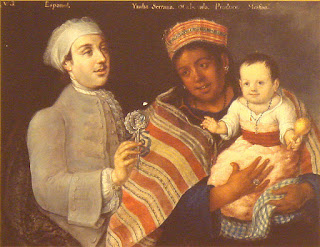
If he'd been dark like the rest of his family, it'd be more readily understood that his references extend beyond European ancestry to include the genetically dominant coloring of indigenous peoples. Like being "yella" among African-Americans signals bi-racial, a specific type of red/tan skin-tone marks Metis as "different" right away, especially in combination with black eyes and high cheekbones. It immediately sends a message to people, who pick it up as visual shorthand for "ethnic". 

But, just as skin color alone doesn't define the black experience, so non-indigenous parenting does not exclude or presume a cultural mismatch between, say, a squaw and her French, fur-trapping husband. Some cultures, even geographically dissimilar ones, get it, like my African-American friend and her Irish-American ex. Their daughter is easily discernible as someone of color because African features are genetically dominant over the weaker recessive genetics Northern people have from less exposure to direct sunlight, like blue eyes that often suffer from vision impairments because of less melanin.

That doesn't mean they didn't get along. They obviously did, and in no small part because Irish people have long been considered the lowest ranking ethnicity on the European scale of correctness, so much so that redheads (or "gingers" as they are disparagingly called) have entered our lexicon through sayings that underlie deeply held prejudices against Celts, like "the ugly, red-headed stepchild" as a way of saying someone is unwanted and unloved. A bigger put-down is rarely heard among us. It's a prejudice based on appearances that anyone who's ever been biased against in our society would empathize with right away, and it goes beyond looks.

Celts have long been oppressed for their devoutly Catholic beliefs that are tied to their prolific child-producing ways, which typically marks the lowest class in any society. Large broods make for less resources at home, and as traditionally disenfranchised people, blacks in America would understand Irish tales of woe quite well, especially over a few drinks, which brings us to their next bias as heavy drinkers. Pub society is very important to Irish culture, and so is a fondness for native-brewed drink, which I have a strong taste for as well. It does not include alcoholism and addiction because neither is a good time, beating in the heart of every pub as a cultural barometer to the overall health of the surrounding community.

It also means a lot of my friends and family meet their "soul mates" in bars (or at least they pretend to), because the difference between, say, pint-hoisting cheer and a violent disease can become blurry, especially around closing time. Kenny's parents met in a bar, like that classic joke about a rabbi, a priest, and an Indian chief meeting for the first time at the local watering hole. Quite the set-up. And it was. His Sephardi-looking father, while shorter than his mom, definitely had the same black hair, prominent nose, and reddened skin of his native mother. Unfortunately for my cousin, recessive European genes kicked in for their oldest child with a vengeance, making him tower over them at 6 foot tall with light brown hair, blue eyes, and fairer skin. What was commonly called "attractive" by a European society in the city made him stand out like an awkward white dude anytime he went anywhere with his parents and siblings.

And dark they were. You can see my family reunion photo on this site to pick out the Indians in a snap, where you'd be much harder pressed to single out Kenny. Like my light-eyed middle brother, it made him susceptible to nasty jokes about amorous mailmen delivering to yo' mama when yo' daddy ain't home during the day, which made my brother and Kenny best friends as kids. It made him choose to favor his Irish side for visual (and beer drinking) similarity. But just like being red or partially Christian doesn't necessarily make you a Jew, so did he struggle to define himself by other people's stereotypes.

It's led to some really weird match-ups, like his younger brother Michael's marriage to a much older and less attractive divorced single mother, someone he also met in a bar, as did his sister (my late cousin) with her last two relationships before her passing. Whereas my cousin Kenny can pass for white, Michael and Ruthie had no such luck. Like the Native American actor who portrays a detective on a popular American "cops and robbers" show, Ruthie and Michael were always assumed to be Hispanic, as Nuyoricans became the dominant Latin/Mediterranean-derived "dark" cultures that dominated NYC in the 70s and 80s. Well, that, or Mexican.

In the quest to be suitably paired combined with low tribal numbers (Kenny's mom told us her tribe had only 67 people in it), it's made finding a mate hell on earth. Who gets it?! Michael went with an older Jewish/Italian-looking suburbanite from New Jersey, but I can't see how that can last. Homeboy may be "off the rez", but that don't make Euros easy pickings for the fight. She can't cut it. It means mixed kids are a genetic "grab-bag" that doesn't suit who you are, what you want, or what your expectations about being colored might be.

As a tribe, it means we know she'll try to "rule the roost" like the pushy older woman from her ethnic background(s) she is, and as an Metis male, that ain't gonna fly for too long with any of my cousins, no matter how drunk as fuck your parents were, or how pale the winter turned you. Red sees red. As soon as we met her at a family reunion in Maine, with her outdated 80s hairdo, clothes, and wrinkly tan skin, we knew she didn't belong. Not only looks-wise, but also her attitude and mentality. Plus, she has her own kids from some other guy. She's got another man, bro. Somewhere. Don't make you "daddy" to her, or him, or them kids! Which meant for the rest of the weekend, we addressed him as "Mrs. Michael": a youngblood with a banged-up, older-looking, Euro-broad. Yeah....good luck with that one, son. 
You'll need all the Irish you can get.

Monday, September 5, 2016

Made in China


https://en.m.wikipedia.org/wiki/Shipping_industry_of_China#


The post-Cold War era has given rise to some "new" (old) demons that feed from our collective fears and paranoia about walls we can't see past, and the loss of the self through mass conformity that's reflected in our consumer tastes. Buying, at least to many Ameri-Europeans, has long been touted by advertisers and companies as a way to freely express our individuality, with the unfortunate consequence of the exact opposite, as it so often works in generational trends. Some of it is justified: without world standards for consumer goods firmly in place, every import becomes a case of "buyer beware", with sometimes strange and/or humorous results.

East Asian people of Queens have a fun and actively-thriving "New Delhi" culture we enjoy greatly, with the unforeseen consequence of serious eye infections and other health issues, as the direct result of unchecked charcoal eyemakeup imported from India freely applied as a cosmetic, without the obligatory warning label. And it isn't just overseas goods. American cosmetics have more lead and mercury in them than any of their European counterparts, even "all-natural" products that are supposedly wholesomely made from at-risk bees with their ill-made wax. It's all inter-connected.

As businesses strive to supply already-strapped families affordable toys at Christmastime, so too do they open the door to Chinese plastic goods (or kitchenware with traces of lead) that do not require mandatory testing for stocking (and re-stocking) on our discount "Big Mart" shelves, leaving the average American to presume a level of scrutiny that bests or matches the mind of an actively researching scientist, leaving the hardest hit strata of our society even more vulnerable than ever, in their quest to find better deals priced cheaply.

And some of it isn't unintentionally dangerous either. You'd have to be extremely naive or delusional not to think twice about the pairing of poorly-made Japanese air bags stuffed into German cars sent to an American marketplace with murderous results that doesn't reek of vengeance for our role in WWII. Look what we did to them for their evil actions: we writ (some would suggest) an even bigger horror upon them with an atomic bomb and severe economic sanctions that lead to more hurt, rather than the healing of so many openly infected wounds. Certainly, Oppenheimer deeply regretted the militaristic use of his atomic discoveries all of his life.

It's saturated our consciousness at a deep level, too. Director/actor/writer/producer Robert Redford did a fascinating movie about one man's struggle against the elements while at sea, comically (at first) put into mortal danger by the floating of so many shipping containers from their loosening off a massive cargo ship, now left adrift and filled with those precious Chinese imports of common American brands. And it isn't as remote or exotic as that, either. 

As a production manager and art director, part of every job I worked in publishing is the factoring of their timetables into our U.S.-based manufacturing process, as we calculated the time and cost that it takes for shipments coming off "the slow boat to China" into warehousing and delivery, in order to save our beleaguered American houses precious U.S. dollars. It wasn't always worth it. 

When time was "of the essence", we went with the more direct and timely service that American and Canadian printers can provide. As our industry factored in overseas trade on the daily, we discovered that Asian printers produced low-cost 4-color work, but not the regular typesetting of black type on paper, which ideally marks the best thinking of our American intellects conducting trade, and I like to very much think that our Ivy League at work in media do that better than anybody. Actually, I know we do.

Because our labors are transacted on moral, ethical, and aesthetic levels, in addition to solely economic ones (because we make art and design), it lead to some very interesting discussions. In my early thirties, I violated my "don't date at work" rule with a handsome printing sales rep because he was a sub-contractor to my house, and as such, not technically an in-house employee or my direct report, though one could argue that increased "bonhomie" as the result of our brief coupling would put him in an advantage over me as a managing woman with everything to lose, and it did. Briefly. Fortunately, I'm surrounded by a lot of fuck-ups, and he went on to date his Asian counterpart at his job and our young part-time receptionist, which meant I had way more "dirt" on him and his at-work dating indiscretions than he had over me.

But I learned some really interesting facts about the huge Chinese printing conglomerate he represented stateside, because our original outside-of-work meetings were just that: questions-and-answer sessions between a buying manager and her main supplier, albeit in a hip "fusion" restaurant with moody dim lighting that used the blending of Brazilian food and Japan sushi to market themselves to craze-craving New Yorkers (usually from out-of-town) hungry for the latest exotica, and this Midwestern tool definitely fit the bill. 

Turn out, his company's highly competitive pricing was the direct result of China's mass-production mindset, which utilized an offshore island as their main base of operations for international buyers of their worldwide printing concern, which further meant (and always means) that they are violating human rights somewhere in their production queue at sometime, as they always do when they use their "extreme conformity at any price" mentality that the Chinese try to market as a social system of governmental reforms meant to combat oppression and corruption. Uh, no. 

He informed me that the Chinese people at the factory worked in 24/7 shifts, and that they could implement such an extreme rotation of their staff by supplying us with a total inconsistency in their staff  (because they always change hands), combined with a brutal enforcement of mandatory shifts that are "4-months on/4-months off" work schedules, in which employees are allowed back home to the mainland to recuperate and visit with their families. Wow...that sounds intense. "I know!" he told me enthusiastically. This was the kind of stuff tourists thrived on in our town, pre-recession. "It's nuts! Sometimes monsoon season cuts them off from the mainland for awhile, which means they lose the window of opportunity to go home and see their families for holidays!" Yeah, that would be communism for you.

It kinda dulled any zest I had for producing potential card packages from our lesbian designer, who wanted to push them through our gay sales rep, that resembled so many vagina shapes in cheesy flower photographs like the rip-off Georgia O'Keefe it was. The world could definitely do without these. No need for some horrow-show factory system. He told me that they slept on cots in constant day/night shifts that left them confused, sleep deprived, careless, and almost impossible to communicate with. Every layout went through several translations from English-to-German-to-Mandarin and back, because I saw the markups from our returned card and calendar layouts. What the fuck...

After awhile, I began to openly despise their stupid-looking calendars that we made for their similar conformity-minded and mass-produced wackos, at a price they could easily afford. So much pain and heartache for nothing that becomes so much toxic landfill after it's done. When every crazy employee at that small house turned on me, in an effort to push me out the door, I was horrified to discover that I might have to punch my way out of the job by besmirching my fellow employees, which they'd already done to themselves. I don't want to do that. I don't want to be like them. "Yeah, but you may have to," said our gay sales rep to me, in our last closed-door meeting before my supposed "ousting". Fine, if that's your twisted priorities over dignity and respect. You can have all that pain and hurt. I have this.

Saturday, September 3, 2016

Banned!


It's probably no secret to you, my steadfast readers, that I face difficulties wherever I go, and that I consider it a frequent and unfortunate part of my life. I was "banned" from the local library recently for my astute and well-targeted observations about their deliberate misuse of the space and intentional misallocations of public funds (as well as our public trust), but more on that later.

Suffice to say, it is a matter requiring deeper investigating, and happily, my network is solid enough to overcome most of the societal obstacles we encounter, either as individuals or together as a group. Since I still consider myself rather new to the "Fame Game", I lacked the publicity-driven foresight to have a photo op with our visiting "men in blue", though I did express to them my relative delight about being in similar circumstances to another famous female New Yorker, albeit without the bleary-eyed mug shots, telltale orange jumpsuit, occasional acting career, and several raging brain disorders openly manifested. Maybe next time.

I have something far greater, so much so that it can be see as either extremely threatening or benevolently fortuitous, and it pays to know the difference betwen the two. I have real power, and I have all of you. That's the strength of my position, because with it, we can move mountains. Within a day, I bought a Wi-Fi enabled tablet with a keyboard for $65 at my grocery store, with my good neighbor's permission to piggyback off his Internet access, so I can now write to you from home. It speaks of my dedication to you, and that the opposition is afraid of us. Good! We can't lose, because....guess what? We've already won.

Friday, September 2, 2016

SETI


https://en.m.wikipedia.org/wiki/Search_for_extraterrestrial_intelligence#


Just like my physics professor predicted, a lot of students quit his class after a brief introduction to the upcoming semester's coursework, an experience that was duplicated for me at RISD, too, without the intentional bait-and-switch routine necessary for a savvier New York student body that uses English as a first language. I had signed up for a class I thought was "Science Fiction Illustration" that was a catalog misprint of the actual class called "Scientific Illustration". A bunch of us (mostly guys) groaned, got up from the studio tables, and immediately asked for a signature to drop the class. 

The teacher was not pleased; profs lived and died at schools based on class attendance and their lectures, and as much as I liked botanical art, I really didn't need a class in it. I had a mom for a botanist. I grew up drawing plants, trees, and flowers in vast pictorial landscapes. This was no place for me to draw the big beautiful trees of my native Hudson River valley. I could do that at home, on my own. She gave me a nasty look as I opted out of her class, a feeling I felt she might have carried over into the next class of hers that I took, which is every high-achieving student's greatest fear: retaliation and blacklisting based on their agenda as a working artist and not mine as a paid-in-full student.

Both of those fears came to fruition, and by the time I had sussed out the art school game, neither retaliatory actions counted against my post-graduation successes. In fact, that particular prof asked for one of my pieces I had made based on organic forms for the RISD Museum's permanent student collection, which bolstered me enough to tolerate her scathing criticisms of any work of mine that she found derivative, which was accurate for me. I can achieve stunning originality, but with an entire course load devoted solely to labor-intensive studio-work, occasionally I had to phone in a piece between my three part-time jobs.

Our physics professor knew better flagging spirits and intellectual tiredness. He looked haunted by his experience and subsequent failures at the famed S.E.T.I. project that proposed highly intelligent beings would respond to something as trite as a radio signal blasted into space. So what? I'm not channeling anything or anyone alien to earth right now as I sit writing to this to you while listening to my playlist (Dizzy Gillespie's live version of "Swing Low" set in Paris). It was kind of a dubious quest to begin with, and I think that's what did it in for him: the absence of faith in his original artificial construct. 

But, he should have quickly recovered. After all, that's what science and experimentation is about: a series of failures that eliminate choices through an inquiry process, leading you to the correct solution that will hold up under scrutiny for its tried-and-true testing. After a class that found me and my boys sitting closer to him in the classroom, we decided to pull back to the higher seats in the lecture hall. Something about his haggard expression and deep-set undereye bags disturbed us up close, like it was unnatural. You have to be pretty bad off to screw up star-filled nights shining brightly in the crisp, clear, cold mountain air we lived in, as a place very close to nature.

He seemed to be pleading at us, as students sitting in the second row of the classroom, with his foot propped up on a pull-down seat's armrest, looking down at us like we didn't know what was up. "I mean, there's nothing out there!" He said to us, in exasperation. "NOTHING!" He acted blown away by it, like a space alien or lifeform that can traverse time and space through wormholes would give a fuck about his petty ego problems, which is what my man DutchBoy basically said to him. "Yeah, but didn't you know that when you set up the experiment? That it could fail? I mean, science isn't about foregone conclusions." Right! Like, adapt and problem-solve, dude. Let's build a spaceship instead! It should've closed down one avenue for him to explore another, but he was stuck on it as a theory, which is a bad place for any scientist (or student) to be. Time to move on, bro. 

It revealed to me just how limiting my education could be at Oneonta, which helped motivate me to undergo one of the hardest experiences of my life that is the Rhode Island School of Design's admittance process. If I remained on "Easy Street", I risked limiting myself to the intellectual capabilities of someone who mistakenly thought that the key to enlightenment with an eternal deity was to simply blast his BabyBoomer songs into the galaxy like some kind of intergalactic space jam. Someone tapped the "red hair bud" going around campus too hard this winter, bro. Word. And like that, I was ready to tackle the bigger questions of the universe, like: how do I get my snow dog with lots of fur into a spacesuit and decompression stasis chamber? Still need help on that one, NASA. Any day now, right?

Thursday, September 1, 2016

Psychic Friends Network


https://en.m.wikipedia.org/wiki/Psychic# 

Certain generations develop a type of "groupthink" that transcends their immediate presence, to become indicative of a much deeper action taking place than that which it would openly appear to be. Because me and my classmates were forced into extraordinarily difficult life situations coupled with extreme stress, we had to communicate without exposing it to the very people supposed to protect us, our parents, who would retaliate any action they could perceive or stump as a threat while in their delusional states. I know it's as intense as it reads.

I have never (NEVER) met a GenX'er who was not physically, emotionally, mentally, and sometimes sexually, abused to the extreme. Under our parents bigger and often stronger hands, we had to make quick life-changing decisions "on the fly", though it is not something we wish to replicate in any other generation. Sanity and hindsight will do that to you. It left us to contemplate just what the fuck went wrong with the sick people around us, when we had the time and space to do so, which, for me and my friends, meant our successful escape to an away college, as a time period of such happiness and fulfillment that it ever marked in severe contrast those later times when we felt just as unfulfilled as we had during our entrapped childhoods.

We had been tasked, as children and teens, to heal every serious adult woe that existed including, but not limited to: alcoholism and addiction, sexual dysfunction, homosexuality, their media-touted "mid-life crisis", adultery, divorce, joblessness and homelessness, extreme over- and under-spending, bad healthcare systems and the medicated side effects of their genetic disorders like madness and dementia combined with schizophrenia and a bevy of scientifically complex mood/identity/personality disorders with a lack of available and appropriate treatments that threatened immediate bankruptcies, foreclosures, and debt, along with not-so-handy alternatives like debtor prisons and/or incarcerations (or foster care) through corruptly inept social services and justice departments. Like, everything that the world has to offer us as severely marginalized individuals.

As a really small generation, we found that our dire circumstances necessitated an unforeseen sophistication to our brief interactions, squeezed as we were by our parent's (and/or grandparents) acute paranoia, which meant that all of our household communiques were strictly monitored for any signs of advanced thought or problem-solving abilities that would conflict with an illness that took on biblical proportions, in direct contrast to our religious ethics. We were "wrong" for simply existing in the covering chaos that evil thrives in, susceptible as our families were to it, in their sicknesses. We became adept at "reading" our emotions well with just a glance or a look, which often only increased the paranoia of the less adept around us.

Survivors of bipolar families like ours often describe in alarming detail (to them, not us) the "rock-and-a-hard-place" space that the severely mentally ill impose on the people around them, as a boxed-in corner where you can either choose death or their abuse. I'm not kidding or using an arty metaphor, either. We had death-defying car rides with stoned drunks as children trapped in their back seats, or rocky water rides down spring-filled rivers that became ego-driven contests with parents hellbent on destruction in the face of our greater gifts that were designed for service but refused through wanton pride.

It's a hard thing to prove as a child, and even harder to describe without the evidence that our families would just as wantonly destroy, in fear of prosecution or exposure. That's how entrenched their untreated sickness became. They'd rather die or kill us, or at the very least hurt us badly, than admit to any wrong-doing or making of mistakes. It was an incredibly selfish and spoiled thing to do, and I remain aghast at my parent's immaturity, as I am in awe of our relative composure in the face of their extreme carelessness. I've been told that I am extremely "lucky" to be alive, but I know it's not luck. It's me, and my extraordinary band of "freaks" that you call "superheroes" or "X-Men", if and when the mood or the money strikes you. Try living it.