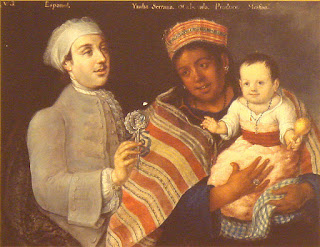
Being American is a funky experience, because we have more inter-cultural diversity than any other nation, which makes for some interesting combinations. For some of my Berkowitz family members, it's led to new waters where the Celt, Jew, and Native American combine, which means my oldest cousin Kenny "passes" for white, while his younger siblings did not. I use "pass" with quotation marks because like other mixed communities, parentage cannot often be assumed by appearance alone, which is probably the reason my cousin acts out so much.
If he'd been dark like the rest of his family, it'd be more readily understood that his references extend beyond European ancestry to include the genetically dominant coloring of indigenous peoples. Like being "yella" among African-Americans signals bi-racial, a specific type of red/tan skin-tone marks Metis as "different" right away, especially in combination with black eyes and high cheekbones. It immediately sends a message to people, who pick it up as visual shorthand for "ethnic".
But, just as skin color alone doesn't define the black experience, so non-indigenous parenting does not exclude or presume a cultural mismatch between, say, a squaw and her French, fur-trapping husband. Some cultures, even geographically dissimilar ones, get it, like my African-American friend and her Irish-American ex. Their daughter is easily discernible as someone of color because African features are genetically dominant over the weaker recessive genetics Northern people have from less exposure to direct sunlight, like blue eyes that often suffer from vision impairments because of less melanin.
That doesn't mean they didn't get along. They obviously did, and in no small part because Irish people have long been considered the lowest ranking ethnicity on the European scale of correctness, so much so that redheads (or "gingers" as they are disparagingly called) have entered our lexicon through sayings that underlie deeply held prejudices against Celts, like "the ugly, red-headed stepchild" as a way of saying someone is unwanted and unloved. A bigger put-down is rarely heard among us. It's a prejudice based on appearances that anyone who's ever been biased against in our society would empathize with right away, and it goes beyond looks.
Celts have long been oppressed for their devoutly Catholic beliefs that are tied to their prolific child-producing ways, which typically marks the lowest class in any society. Large broods make for less resources at home, and as traditionally disenfranchised people, blacks in America would understand Irish tales of woe quite well, especially over a few drinks, which brings us to their next bias as heavy drinkers. Pub society is very important to Irish culture, and so is a fondness for native-brewed drink, which I have a strong taste for as well. It does not include alcoholism and addiction because neither is a good time, beating in the heart of every pub as a cultural barometer to the overall health of the surrounding community.
It also means a lot of my friends and family meet their "soul mates" in bars (or at least they pretend to), because the difference between, say, pint-hoisting cheer and a violent disease can become blurry, especially around closing time. Kenny's parents met in a bar, like that classic joke about a rabbi, a priest, and an Indian chief meeting for the first time at the local watering hole. Quite the set-up. And it was. His Sephardi-looking father, while shorter than his mom, definitely had the same black hair, prominent nose, and reddened skin of his native mother. Unfortunately for my cousin, recessive European genes kicked in for their oldest child with a vengeance, making him tower over them at 6 foot tall with light brown hair, blue eyes, and fairer skin. What was commonly called "attractive" by a European society in the city made him stand out like an awkward white dude anytime he went anywhere with his parents and siblings.
And dark they were. You can see my family reunion photo on this site to pick out the Indians in a snap, where you'd be much harder pressed to single out Kenny. Like my light-eyed middle brother, it made him susceptible to nasty jokes about amorous mailmen delivering to yo' mama when yo' daddy ain't home during the day, which made my brother and Kenny best friends as kids. It made him choose to favor his Irish side for visual (and beer drinking) similarity. But just like being red or partially Christian doesn't necessarily make you a Jew, so did he struggle to define himself by other people's stereotypes.
It's led to some really weird match-ups, like his younger brother Michael's marriage to a much older and less attractive divorced single mother, someone he also met in a bar, as did his sister (my late cousin) with her last two relationships before her passing. Whereas my cousin Kenny can pass for white, Michael and Ruthie had no such luck. Like the Native American actor who portrays a detective on a popular American "cops and robbers" show, Ruthie and Michael were always assumed to be Hispanic, as Nuyoricans became the dominant Latin/Mediterranean-derived "dark" cultures that dominated NYC in the 70s and 80s. Well, that, or Mexican.
In the quest to be suitably paired combined with low tribal numbers (Kenny's mom told us her tribe had only 67 people in it), it's made finding a mate hell on earth. Who gets it?! Michael went with an older Jewish/Italian-looking suburbanite from New Jersey, but I can't see how that can last. Homeboy may be "off the rez", but that don't make Euros easy pickings for the fight. She can't cut it. It means mixed kids are a genetic "grab-bag" that doesn't suit who you are, what you want, or what your expectations about being colored might be.
As a tribe, it means we know she'll try to "rule the roost" like the pushy older woman from her ethnic background(s) she is, and as an Metis male, that ain't gonna fly for too long with any of my cousins, no matter how drunk as fuck your parents were, or how pale the winter turned you. Red sees red. As soon as we met her at a family reunion in Maine, with her outdated 80s hairdo, clothes, and wrinkly tan skin, we knew she didn't belong. Not only looks-wise, but also her attitude and mentality. Plus, she has her own kids from some other guy. She's got another man, bro. Somewhere. Don't make you "daddy" to her, or him, or them kids! Which meant for the rest of the weekend, we addressed him as "Mrs. Michael": a youngblood with a banged-up, older-looking, Euro-broad. Yeah....good luck with that one, son.
You'll need all the Irish you can get.