Showing posts with label violence. Show all posts
Showing posts with label violence. Show all posts
Wednesday, November 9, 2016
The Mat Room
Fraternities and sororities at Oneonta existed mostly for the hardcore suburban Long Island crowd who went to the same high school together (which seemed like a pointless thing to do in college), or those downlow weirdos too embarrassed to join the unisex organization of social do-gooders with the purple triangle logo on their Greek shirts, ya dig? With the high-priced fees that came with "rushing" during pledge, me and my crew thought it was crazy to pay to have friends when you could just throw a kegger and kids would show up, anyway, once the word got out around campus. We had more trouble containing a good time than publicizing it.
Still, a slow Wednesday night with no Thursday classes could find you extending beyond your typical routine to include off-campus frat parties, especially if one of your boys roomed with one of their "frosh" pledges. It meant we might catch a break with the cover charge. Five bucks blown on skunky stale beer or a drained keg meant you just walked down a mountain in a snowstorm with nothing to show for it besides missing dinner at the cafeteria. Oh, well. You'd have to wait until the morning, if you didn't stash food in your room from lunchtime.
I'd been to few of them without incident, which must have driven the crazies wild, because I found myself alone in their basement kitchen thumbing through an old issue of NatGeo I'd found on the counter (with its distinctive yellow border) while my friends made a run for the keg, when some douche came over to make a rude comment to me about the partially nude African women depicted in the magazine. It was a shocking thing to do at a hip New York school with a lot of urbane city kids, but certain pockets of the state bred bad stuff that we didn't have close at hand growing up, though it was certainly around.
He was obviously drunk, too, and he had a wild angry look to his bulging glassy eyes that made him doubly dangerous. Psychotic drunks were a serious hazard at any party. Most gatherings I went to were attended with my large boyfriend, but without a big bouncer around, anti-social headcases could take the time to hassle you and feel comfortable doing it with their similarly challenged friends. As soon as he targeted me, he flipped on me, demanding to know who I was and how I got into his party. I was trapped against the kitchen counter, alone in the room with him.
I tried to look past him to catch the eye of someone, anyone, because I couldn't see the heads of my friends over the crowd in the living room. He got in my face, yelling about who the fuck did I think I was to rebuff his advances in his frat house? It was insane, and it got out of control within seconds. Some tall guy finally came over to see what the commotion was about, because the kid wanted me thrown out of the party, which was fine by me. I'd had enough. As bad as it was, that was nothing compared to the stories I'd hear walking home that night.
As we walked around collecting our friends after my "ousting" from their lame party, I caught a glimpse of a dirty room, behind a partially opened door, covered in graffiti with bare mattresses on the floor. During the party, we'd been told that it was a makeshift crash pad for brothers too drunk to stand, but that's not what another girl at the party told us. She whispered to our small group that it was the room they took girls too drunk to resist. It was their rape room. And it was the last frat party I ever went to.

Thursday, August 18, 2016
Incredible

Comic books were a big part of my brothers lives growing up, and by extension, mine, too. Because we were so often put into situations we couldn't control as children, we naturally turned to any medium that offered us a respite from the abuse around us. Nowhere was safe, not even the tree house we built in the backyard, because my parents had long ago established that they could get to us, no matter where we were. They considered us their property, and they would stop at nothing to remove any barriers that blocked their access to us, including the cheap thin doors with easy locks you could undo with a thumbnail or a knife from the kitchen, which was part of my mother's hysterical scenes. I briefly had a diary for a day, before my brothers found it and read it aloud at the kitchen table with my mother's approval. "You shouldn't keep secrets, Marie." She did.
There was one set of rules for my parents, and another set of randomly changing rules that suited either their mania or their depression, depending on how they felt, though they would never articulate it as such. We were always to blame, for any household infraction big or small. They acted like desperate street thugs afraid of getting busted by the police, which, in essence, they were to us: criminal in the extreme. Heroes were very hard for us to find, because other than me—or occasionally my brothers and grandparents—we didn't know any. I mean, none, and we come from a huge Catholic family. Since the bulk of my parents power came from their status as bigger adults to much smaller children, they used their physicality as their number one weapon against children who did nothing wrong besides exist.
I had all the proof of that that I needed, what with our good grades and frequent church attendance, though in later years, everyone in my family would use a bogus faith as a smokescreen to hide their real infractions, but not me. I thought it was hypocritical bullshit, because my parents lied all the time to my face, which as blown off easily by "don't do as I do, do as I say", which meant I was always better than them, and I knew it. They knew it, too. I didn't have the arrogant smart-ass mouth of my oldest brother, or the stone-cold demeanor of my deadened middle brother, because I was truly alive in their sea of sickness. Of course, with time, their tactics became more brutal and concerted as I grew older, which signaled clearly to me that my brain power was terrifying to them and so was my beauty, so much did they try to hurt me when I was stuck in the home, also by their contrivance.
The only solace I ever found—amid their suddenly stormy attacks that could sink into sullen silences lasting months or years—was among the books that were written by much better people than the ones I was surrounded with daily. I knew someday I would join their ranks, because I understood their writings much better than my family's virulent mental diseases. And so, when a t.v. show came on about a comic book superhero we admired, psyched didn't even begin to cover it for us as kids. Bernard, in his fear about being beaten up, was drawn to the "The Hulk" character who would turn into a strong beast whenever he became really angry. It mirrored my brother's ongoing struggles with a violent psychosis stemming from his emotional problems, manifesting itself into bursts of uncontrollable anger that both scared him and protected him, too, just like the comic read.
When we found out that the actor portraying the Hulk in the t.v. show was an Italian-American from the city (just like us!), we were ecstatic. We couldn't read enough about him in our fanzines, hoping to catch a glimpse of him at our comic book conventions at Madison Square Garden, not that I would take a typical fan photo with anyone: too shy. We'd tell each other fun facts about his life, like the muscle movie he made with Arnold Schwarzenegger that was a huge hit, with both actor/athletes going on to star in movies and shows about mythical comic book action heroes. It was an epic time to be a kid. And when we found out that he was successful despite his deafness, we hero-worshipped him like no other star from our childhood.
Our grandmother was deaf, and so was our aunt, with my father and I also joining the genetic ranks of profound hearing impairment that is the inherited deafness running in my paternal line. We'd cite lines from his interviews like "Did you know that Lou Ferrigno has a 'deaf voice' he tries to hide, so he went for a t.v. role without any speaking parts?" Fascinating! He'd been born deaf! We loved his triumph over adversity in real life that meant he wasn't some typical show business phony from Hollywood who'd sing anything for a buck, like a cheap sell-out. He was for real, yo! We read with avid interest about the special earpiece he wore in his ear for stage directions from the sidelines that made us cheer even louder for him whenever he appeared on screen. "Change! Change! Change!" We'd root for the "monster" in each and every episode, over the lamer Bill Bixby character. What a wimp!
Of course, as savvy New York City kids, we knew that a lot of bodybuilders took steroids to get big, but we reasoned that Mr. Ferrigno had probably been forced into it, as part of his Hollywood success, because he had a serious handicap he needed to compensate for, we reasoned out loud to each other. Unlike the other seriously delusional people we knew, we weren't looking for god-like perfection in our 'hood heroes. To us, he was great just the way he was: a city kid who'd made good, coming out of the mean city streets. That was enough for us. And it's more than enough now, though by his photos on social media, I'm proud to report that he looks as amazingly healthy as ever, and I know he doesn't need any drugs to do it. He has a really hard work ethic, just like us. Sometimes heroes are real!
Friday, September 11, 2015
A Thousand Points of Light
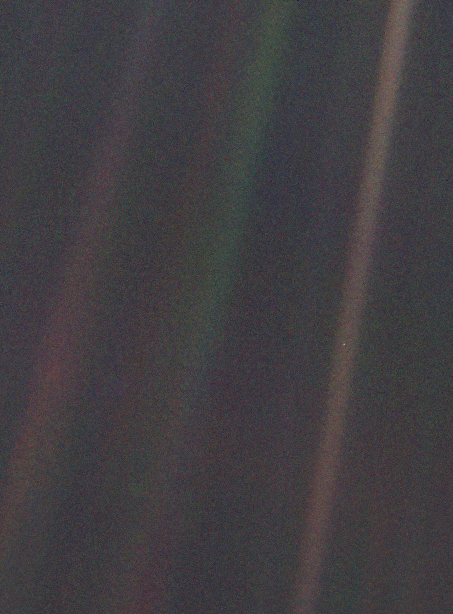 |
| https://en.wikipedia.org/wiki/Pale_Blue_Dot |
Like a lot of native New Yorkers living outside of the country (or smack dab in the middle of it like I was), news of home and murder struck us deep at our core, and like many of my friends, we took it as a beacon of light in the fight against the dark that spreads through the human condition where we cannot see it, deep within our souls. I came home as soon as could, with a full grown Mal and man in tow, in a crazy road trip adventure that was fraught with many perils, but make it I did.
Of course, that man soon realized all those t.v. shows and movies depicted a reality about my home that he was not prepared to accept, but I accepted the return to the homeland of my birth as a necessary burning up upon re-entry. Ain't nobody gonna move me from this.
And so I set out to reconnect with my old network of former classmates, college pals, and work acquaintances, trying to pick up the thread of life in our big city once again. It was overwhelming: I was flat broke (typical for single women), had one of the highest rents in the country to make every month (alone), on a paycheck that did not include food, or clothing, or electricity, because no one in the city gives a fuck about you or your comfort. It's sad in a way, I suppose, but everybody is just trying to keep their heads above water, in the most vicious waters urban man has ever created. Population and competition do that to people, like Rhesus monkeys fighting for peanuts at the local zoo: people zone out, stepping over homeless humans like they're a discarded pizza box, but what can you do? That bum is schizo and he might knife you. Besides, you'll get fired from the job that keeps your head just above the poverty line, and you'll soon be homeless, too, if you don't hurry into work.
That's life in "The Big Apple". It's a near-constant Round Robin* game of crisis care, like an Emergency Room on any given night throughout Gotham: who lives, and who dies? We call it "The Rat Race" here for good reason, because sometimes the vermin outnumber the amount of humans who give a rat's ass about you, and that's on a relatively peaceful day. Know what I mean? It changes you: how you think, look, and behave. Yeah, it makes you stronger, faster, smarter, and tougher, but you learn to let those little things go over the catastrophes, losing sight of the details that pile up in the face of neglect.
I certainly wasn't alone. As part of my "Reconnect" campaign, I briefly became a "joiner" of clubs and associations, at least temporarily, while I made crucial connections. With my safety, security, and money in mind, I forced myself out into the nightlife of Manhattan, typically after rushing home to Brooklyn from work to walk my dog, change my clothes, and take the train back into town, usually because people become snobbish about boroughs at the slightest suggestion from an out-of-towner. Yeah, I know. Women lead brutally hard lives. On one such night, I sat alone at the bar that some local actor bought with t.v. series money about life in the city. But not for long. Within minutes, I chatted with an attractive lady sitting next to me to learn that, yes, she too did design work. Well, yeah. Most of us do that at some point.
We quickly became friends, and branched out from our two bar stools to include other RISD alumni within our conversations. Out of the corner of my eye, I saw a guy speed past me like a blur, and then I thought I heard my name. "Hey! Beau!" Turned out to be a guy I had gone out on a date or two with, made out with one time without sex, and then never dated him again. He avoided me in classes after that, and I never really knew why, although hardcore dysfunction was definitely part of my short list of reasons. He fit the criteria: well-to-do, infamous dad, artsy Jewish family with lots of creative connections, etc. You know the type. Handsome but distant, like he's got a million exciting things going on, but honestly, it's creative procrastination.
Anyway, we reconnected as friends, in the same dithering slightly romantic way we had made contact at school with. He was still attractive and young, and so was I. He was entering a Japanese firm through Marketing, that standby for artists when the art and design department thing doesn't work out for you. We were all trying to make our way in Post-911 New York. He'd come back from teaching English in Japan after the attacks to enlist in the NYPD. The force didn't work out for him, for obvious reasons, but I admired his response to a call-to-action. I felt the same way about my people, too. This is our home.
We fight to defend it. Makes sense.
We became reacquainted and spent some time together, mostly drinking his food of choice, like Sake and Sushi, so he could show off his knowledge of Japanese to me, but we occasionally connected on a deeper level. One 9/11 night was one of those times, when we broke through the petty show-off competition of visual genius to throw some light on what it means to really belong to a culture, like he and I do. He was trying to work on series of paintings about his brief time on the force, like his Jewish Upper East Side gallery agent suggested he do, because his pretty but lackluster Japanese landscapes kind of fell flat. I didn't mind. His rich kid edge was the same energy I met with at school. Why would his life here be any different for him? It wasn't really, as I watched him muddle through his intense feelings about seeing murder and the worst of humanity firsthand, for hours at a time.
I didn't think it would go far due to his emotional constipation, hence the whole codependent thing he's got going on with his folk in their Village apartment, because processing wasn't high on his family's list of accomplishments. His sister still slept on his parent's couch at the time, supposedly because she was the victim of a sexual assault that left her traumatized, but after my brush-ups with the insane, I knew it could be untrue. Besides, his parents covered for her constantly in her infirmity, and I knew all about that, too. I covered up for my family more times than I could count, being an abuse survivor all my life. I knew the consequences for speaking up against mental illness in the home.
It was in that context that he invited me to see his cool art studio housed in a trendy brick building that was formerly a warehouse in the Meatpacking District, on the very night we mourn our dead. After touring the facilities, we made our way to the roof with a bottle of wine. It was cold out, as September nights that edge towards Fall are. Besides the uncomfortable fumbling around that passes for flirting with the disordered, I could see the twin lights of the former Trade Center site from atop the building, and I still can't really explain what I saw accurately. It was like there were a thousand little lights twirling, dipping, and swooping independently within the two upward beams, of their individual volition. It was eerie, fantastical, and utterly miraculous.
I asked him if he saw what I saw, and we spoke briefly about it.
He dismissed it as dust motes, but what kind of matter moves like that?! I tried watching the evening news for days afterward, as well as intermittently searching the web for other witnesses to the events of that night, but I still don't know what happened. I don't know what I saw, except that it looked like the dearly departed souls had become a thousand points of light** in the night, a cluster of brilliant fairy lights brushing up against one another as they surfed the warm updraft of the hot spotlight currents. It was joyful and free, and I have the same chill goosebumps writing about it in this library's air conditioning as I did on that windy night in September, when I wasn't a human warrior on a mission to save the world with my friends, but an artist who could really see what life was about: the beauty of it, the pathos of it, the sometimes tragic and hopelessly beautiful quality to our unique lives that makes the world go 'round. Do you know what I mean?
I hope you do, because that feeling was more real to me than any of the words spoken to me that night by a New York kid who would never make it out of his head to achieve great success, despite every advantage that was rigged for him through a Capitalist system designed for his particular benefit. He was a victim of circumstances beyond his control, like the synapses in his brain that constantly misfire, as mysterious to me as the cosmic forces that drive stardust across the night sky, but such is the mystery and marvel of our faith. Amen to you today who have suffered at the hands of others who do not love you like I do. I understand you, and I can feel your pain. I can help. We'll be here for you, when you're ready. I am the light at the end of the tunnel. Come home to me.
* https://en.wikipedia.org/wiki/Round-robin
** https://en.wikipedia.org/wiki/Thousand_points_of_light
Wednesday, August 12, 2015
James Hendricks

It was the thing to do back in the day: hop on a bus to the city, or catch a ride with a friend, and grab a fake ID from one of the shady vendors that lined Times Square. In terms of illegality, it was on a scale on par with buying beer while underage, hence the phony driver's license. Hand skills were also highly in demand. If you were good enough as a forger (and I was), you could erase the info on someone's license and type over the last number that placed you as a minor. If you still had a ways to go, and you needed two numbers changed on your birth date, it was a harder sell.
Bouncers were pretty savvy, especially when the drinking age in New York was 18, and that was the glorious age my oldest brother fell under: a time when you could be a teen and drink in a grownup bar. It seemed less a crime to fudge one number when you didn't have that much time left to go, anyway. For me and my middle bro, it was way more difficult to get away with, because they raised the legal age to 21, and there was absolutely no way I could pass for someone older. I barely passed for a teenager as a kid, let alone someone who could amble up to a bar and order a real cocktail. Besides that, I didn't really like the taste of alcohol.
My brothers passed their fake ID between the two of them, because in the dark of night, photos were less important than the age. Woe to you if you got a smart guy at the door, like someone who knew how to shine a flashlight underneath the unlaminated paper license to read the real numbers under your typewriter job. Then, you could be really fucked; like, hauled down to the station fucked. And any parent from this area who gets a call like that at night does major damage to your psyche for an indiscretion like that. You don't wanna know what strong-ass parents from the Bronx and BedStuy do for discipline, although by now, I'm sure you have good guesses, most of which is now considered illegal to do to a child under current laws. You could get punched right across the face, like my bros did for really serious infractions, for lying about a sleepover to go see a Stones show in Philly. It was really bad and very scary, and that was the whole point.
 |
| http://gothamist.com/2013/11/22/1970s_photos_show_a_dirty_old_city.php#photo-1 |
We lived in very dangerous waters, and my parents figured it was better to be scared of them than us taking crack addicts on the subway lightly, and in many ways, I didn't disagree. It's hard to come down on the strictness of parents terrified of being knifed on a train during daylight commuting times, or the hellish cast a flaming garbage can had at night on the West Side Highway, intimating the fiery pits of hell, which is exactly where you'd be if you broke down on the wrong side of town, late in the middle of the night, where no one (not even the cops) dared to go. We faced big-time foes, not some tweaked-out little "wigger" with hipster neck tats, a sideways ball cap, and a copped bad attitude, like a suburban kid from Mount Vernon who took the Metro North into "the city".
In comparison to that, who wouldn't need a drink? We reasoned to ourselves as a group that it was insane to be involuntarily pressed into military service without being able to take a stiff drink beforehand. We could die for our country as bullet fodder, but we sure as fuck couldn't dull the pain from it. War before alcohol: an American example of our tendencies towards violence over drink, if ever there was. Doubt me? I've seen movies in the past few weeks (new releases, too), that toss real children around like they're nothing but rag dolls, or they used sled dogs like they are trash to be jerked around on a leash for some stupid fucking movie, with one star punching and pushing away an obviously real animal. Disgusting stuff, and not exactly the red wine with cheese my parents liked to have sometimes.
Compared to a climate like that, an older brother with a penchant for really good music could only mean one thing to me: the mischievous spirit of the 60s lived on and still rebelled, every time some dumb dick bouncer with a high school dropout education and a guido fucking attitude didn't discern what any of our crowd knew at a glance: we were (and always will be) Jimi Hendrix fans. R.I.P., my native brother. And fuck y'all with your weird priorities. Rock lives on forever! We will never really die, because the truly gifted never really do.
 |
| https://en.wikipedia.org/wiki/Jimi_Hendrix |
(For Jim)
Monday, September 15, 2014
The Rabbit Head
 |
| WTF?! |
Instead of play, my Barbie doll got a Mohawk haircut that I dunked into a paper cup of blue food coloring on the kitchen counter, and we froze my brother's Stretch Armstrong doll in the freezer, just for kicks, to see what the red goo inside would do. It cracked into big chunks after we took it out and threw him onto the hard kitchen tiles. Oh. Neat!
After that initial experimentation, everything we had was up for grabs.
 |
| Oh, I see. It's "Don't let this be you!" in kid-talk. |
My Kermit the Frog doll was hung by a rope-fashioned noose from the top of the stairs by my brother and our cousin, as a tribal warning to me when I came through the front door about what was in store. Aha! Something was afoot with those boys, and methinks our childhood is officially over. I could fight the tides that be, but true to me, I shrugged it off and joined in the fun.
Kermie went into the dryer, Barbie was blown to bits by firecrackers (after she drag raced Mad Max style a few times in several horribly disfiguring crash-and-burn scenarios), and then we just simply tore things apart. The next year in junior high school, we read Lord of the Flies for the first time. Lesson learned.
Friday, June 13, 2014
Mental Illness: Now Appearing Near You
A cursory list of the latest headlines speaks to the major health care crisis in our country, as a plague that tells its tale in psychosis and gun violence. The "Virgin Killer" in California, who legally bought three separate handguns, posted sick rants detailing his future crimes on YouTube before he committed them. He manifested such extremely violent tendencies that his aunt called the police to alert them about his obvious status as a walking time bomb (http://www.independent.co.uk/news/world/americas/california-killings-elliot-rodger-was-described-as-polite-and-courteous-during-welfare-check-by-police-9432530.html), but nothing happened. Unfortunately, someone has to break the law before legal action takes place, and an intelligent criminal knows exactly where the dividing lines are, much better than you and l. That's their big advantage in the world: shock and awe, for the dual purposes of hurt and destruction. Ask anyone who's been harassed, stalked, or threatened, and they'll tell you a similar story, to the ongoing frustration of law enforcement officers and psychiatric health care workers, and that's just the beginning.
There's a recent spate of murders in NYC, again, perpetrated by an individual so unfit for a place in our society, that his parole officer told anyone who would listen in authority that he would murder someone soon, and then he did (http://nypost.com/2014/06/06/parole-officer-warned-cops-brooklyn-ripper-was-dangerous/). Need more examples? No problem. I got that: the school shooting in Oregon (http://www.cnn.com/2014/06/11/justice/oregon-high-school-shooting/), the psychologist with security clearance who calmly let himself onto an army base to commit what he felt was a "revenge" murder (http://www.cnn.com/2014/04/03/us/fort-hood-shooting/), not to mention the massacres in Colorado, now infamous.
What is it? Where does it come from? Just like conversations about global warming and starving children in Africa, the answer is as old as slavery and murder: because it's a part of human nature. But, how did it get this bad? I have a theory that I'm road-testing, which is quickly gaining support. The answer is this: a greater dissolution between public and private in "The Age of Transparency", because there's less room to hide, and for healthy people like myself, that is a very good thing indeed. What was once hidden at home, like a body surreptitiously buried in the backyard at midnight, way out in the country, with no proof of wrongdoing, has now gone public. Ed Gein lived in a place so rural, he could get away with it. Jeffrey Dahmer preyed on homosexual men, a group that traditionally had very little public support or empathy. "Jack the Ripper" likewise preyed on another famously disenfranchised group, the street-walking prostitute, often a societal target for psychotic rage and murderous intent.
Now that today's individual is much more savvy about the early signs of illness (thanks to the widespread access of such information), those of us who grew up in homes of the sick are often forced into the roles of psychiatrist and law enforcer unwillingly, and that is extremely threatening to someone who seeks to hide their paranoid psychosis with violent tendencies. Children and teens who witness this behavior routinely are groomed to accept abuse as acceptable, as they're gradually conditioned to it (along with the rationale for it) through complicity, similar in method to a pedophile or addict. Who are we to give voice to a major worldwide health crisis? We're nobodies, and that's exactly what someone who is desperate to exploit us counts on, though those rules are changing, too. The kids who are artists, thinkers, and makers are no longer the "kooky" black sheep in their respective families, as "The Digital Age" and the "Design Intelligence" movement now lead the world.
Hmm...who then to disenfranchise, isolate, and victimize? It's become harder to do so, and so the disordered responded by setting up their family members through constant vicious attacks in secret, sabotaging them until they appear to be the opposite of what's true in public, because that's what bad parents do. I saw a story in that vein just yesterday: a girl was raped, then her crazy parents pushed her into the media spotlight to get attention for themselves, and then they forced her to take to "the low road" through deliberately enforced impoverishment to survive, after they cut her off financially. The result?
A teenage pregnancy and a convict "baby-daddy", gaining plenty of evidence to do her in and discredit her point of view. In order to survive adverse conditions, it's not uncommon among whistle-blowers in the home to be singled out as a primary target for family scapegoating. After all, what can a dependent teenager really do in retaliation? They held all the cards, along with the money and their seemingly suburban perfection, except the facts didn't exactly pan out. Their daughter tested "positive" for drugs while living in their home, and now, safely on her own as a working single mother, she's clean, even with random drug tests, which she volunteered to do: http://www.drphil.com/shows/show/2136.
I saw an episode of "Judge Judy" that was so bad, the bailiff had to warn the defendant by looming over him physically until he was subdued enough to speak somewhat coherently, bringing no defense to the table or excuse for his poor behavior whatsoever, in a brazen show of delusional cockiness that grows worse and worse every day. Another man on the show, in a separate case, lashed out at the judge in a way I'd never seen before. When she pointed out that his crazy behavior was the result of his mental state and medication, he shot back at her (in full view of the public, on t.v.): "You, too! You need medication, too!", and I actually gasped. Another woman was so unmanageable, her entire case was dismissed, because the judge repeatedly told her to be quiet and, red-eyed with rage, she declared defiantly "I will not!". The mentally ill no longer respond to authority figures, public shaming, financial consequences, or the law.
It's become harder for sick people to find targets for their aggression, easy as it is for us to openly view their sick behavior and then testify about it; witness any reality t.v. show nowadays about dating, drinking, and mental illness. They've been forced into the public arena to act out their rage, because our private spaces have become safer from a growing movement of support and education, thanks to the brave people who are willing to speak out, even to their detriment. And therein the problem also lies—because even obvious outward manifestations are not enough to get someone help anymore, like I observed at any one of my office gigs. A sick guy I worked nearby had ranted all day long to himslef at his computer (OCD), within clear earshot of the entire office space, visibly twitching, talking, cursing, and starting from his chair compulsively, something I often see in other public places like subways and libraries.
Where once a family could exert financial and social pressure upon a disordered person, forcing them to conform, the economy changed to our detriment. Now, the sick have power and money, which is more easily done with a damaged morality (http://www.nbcnews.com/news/sports/donald-sterlings-mental-health-figures-clippers-sale-report-n118176). What do you do when those in power are mentally unfit to serve our best interests? My generation, Generation X, was painted as "slacker" because as a population group, we were blocked from implementing change by those same corrupt Baby Boomers who have/had numbers on their side, but just like in life, our time has finally come. In the process we became leaders, as we waited until a new population could respond to our ways of thinking, like Gen Y and Millennials have shown through their abilities to adapt to technology and respond to change, embracing a world vision that's greener, safer, saner, and healthier, not because it benefits them immediately, but because it's the right thing to do.
The answer is dual-fold, combined with better healthcare laws and stricter gun laws. There's absolutely no good reason that a college student like "The Virgin Killer" should legally possess three guns for his "self defense". It's absurdly irrational, these old laws made to please unsafe extremists, and it will change. Healthcare must follow suit. Without better mental healthcare reforms in place, all we can do is cry out yet another warning at our own expense, bankrupting our lives in the process, because self-sacrifice is what a honorable person does while actively seeking change, waiting for the tides to turn. And the tides, ushered along by global warming, are turning.
Welcome to "The New World Order". We've had enough. No longer will the sane cower in fear at the hands of tyranny, because this world operates on one very powerful principle that was previously hidden in the dark, nursed in secret, now reaching its final, unhealthy conclusion as an end to it all, and that is this: transparency.
What a beautiful world it will be.
Subscribe to:
Posts (Atom)