Showing posts with label indigenous people of the Americas. Show all posts

Tuesday, November 15, 2016

The Colony


Despite depictions to the contrary, the continents of the Americas were already settled and populated for millennium before the European invasion, though carefully cultivated propaganda often repeated has done its best to suggest otherwise. In fact, while doing a word search for links to this piece, words like "occupation" and "invasion" were nonexistent when grouped with "European" and "America", replaced by the far more benign and majestic-sounding "Age of Exploration" (rather one-sided), or "colonization", implying that plenty of space was "up for grabs" and available without years of murder, torture, and displacement, which is simply not true.

It is a concept that's also reinforced in Euro-centric schools here in the United States, shown to schoolchildren as the Pilgrims and Indians happily sharing a feast together in what colonists called "The New World". Fellowship and friendship among people isn't arguable, though the intentions of a bunch of rabid nut-jobs like the Puritans were definitely suspect, and therein lies the truth: that "colonists" like them were driven from their homelands for religious extremism and other acts of violence against men, much like the establishment of penal colonies in Australia.

Convicts were often given a choice between prison and expulsion, because a long sea voyage that may be your untimely death was preferable to rotting in jail. Given the feudal system of medieval Europe, it's no wonder their "undesirables" chose a boat instead. The lord/serf system of labor and land ownership was a direct precursor to the slave economy of the American South, and just as deranged. In Europe, serfs were considered property just like they were here, in colonies created for economic expansion and world domination.

Not that it stopped there. With the advent of the media age came new conduits for programming and/or re-programming, as the case may be. Movie after movie after movie showed the handsome white man "dressed to kill" in his ten-gallon hat, armed and dangerous to the savagely murderous Indians who pillaged their towns and raped their women, in an almost direct contrast to the actual battles waged on land already occupied by the First Nations. The hero wore white, the bad guy wore black, and the Indians bled red blood. Done! History for the Special Needs set: easily digestible and almost guilt-free.

Except that it wasn't. As indigenous people fought back harder than any "sophisticated" wealthy euro ever had the right to expect, those territories were left to the natives (now as disenfranchised and often poverty-stricken "reservations" free of U.S. interference), as other less contested lands were carved up by the governments of France, England, and Spain, until a new American identity was born to the children of proudly mixed parentage from "both sides of 'the pond'", which is where we stand today: a nation about to be led by yet another rich white man born to four European grandparents (with an Eastern Euro import wife), who won an election in the same "red" states fed by the southern slave economy that drives them back towards the same rich white man they remain indebted to. And you wondered why he isn't taking a salary for his presidency....<shakes head in disbelief>

Wednesday, August 31, 2016

Colored


https://en.m.wikipedia.org/wiki/Gens_de_couleur

The conversation about race and ethnicity can be a troubling game to the people who confuse it, because they lack proper cultural definitions within an appropriate context. I found myself in such a desert last week, watching a popular news entertainment show that highlights the most offensively outspoken headlines of the day. A prominent white news anchor used the word "colored" in her story about African-American issues and, like the jocks working the radio program that airs on t.v., I immediately took umbrage at her usage of it, too. What the...? Who the fuck is she? She don't know.

And then I remembered similarly odd conversations in my own past, where words can tumble out of control given the wrong situation, at any moment. Take, for instance, my meeting with a professor of English Literature during my time at Oneonta. He'd made some political references to his mostly "Anglo" class (or so he thought) of college students, about his supposed activism in South Africa with famous anti-apartheid movements that led him to flee the country to teach in our small po'dunk mountain town. Huh...really? He was handsome, so I dismissed him at the time for playing the adventurous romantic lead seeking to bed willing co-eds looking for a taste of the East, via one fucked-up African country and this state school educator.

He had a posh British accent that bespoke of his family's rather wealthy position in society through his obvious attendance at expensive private schools, and he had an irritating habit of wearing dopey silk ascots to go along with his condescension towards all things American that extended to decidedly less wealthy New York students, like me. I didn't think that much about him until a visit with my friend Donnel shook it up for me. We were still baffled by the death of her father while he was overseas in Ghana, and the subsequent disappearance of his body kept his whole family on edge, including me. According to their tribal customs, her mother needed to be in attendance to perform ablutions related his burial ritual, and they couldn't get any answers from the government or the state department about the events leading up to his death, leaving us in a paranoid "X-File" state.

There was talk of her father's assassination at the hands of some rival gangs with competing economic interests in their home village area which, given the general instability of many African nations, made more sense to us than we cared to admit. After he died, their financial circumstances drastically changed, revealing how deeply in debt their hereto presumed successful international businessman father was. During their foreclosure, our friend drove us past their house after school, to find deputies putting all of their furniture out on the front lawn, in full view of the entire neighborhood. "Just keep driving." Donnel said to us, crouched down in the back seat of the car. It was really disturbing. They moved to a smaller town home, and her mother began working as a low-end healthcare aide in a nearby nursing home to make ends meet, while we pursued various theories and connections to Ghana and Africa, no matter how bare or small.

During her visit to my college, I told Donnel about my English Lit professor with the supposed activist connections. Perhaps he could introduce us to a few of his contacts? We were desperate for any leads, and truth be told, I wanted to get a better look at him in private, to better feel out his intentions towards our student body. And so, one day after class, I made an appointment to see him in his office, a normal practice for any student seeking help, but totally rare for me. I'd never been to a professor's office before, and it was nerve-wracking to me, especially given the content of my errand. After I sat down in our semi-closed door meeting, I simply told him the truth. My friend's father had died mysteriously while in Ghana, and no one would talk to them about it. What to do?

He gave me a nasty look, then pointed to a map of Africa on his wall. You see, South Africa is there, and Ghana is here. See how faraway they are? Yeah, thanks. Asshat. But, you spoke in class about African geo-politics. Do you have any advice for my friend and her family about an agency that they can contact for guidance and support? He launched into another hipster diatribe about Apartheid and his status as a "Colored" man, because Indians (from India) were grouped in with "the blacks", and here he made a disgusted face like he smelled doggie doo-doo, which signaled to me that he was more upset about his classification as a minority in a faraway land than helping out poor black folks and their friends.

It was an astonishingly douchebag thing for him to admit to a student, especially since India has an extremely poor history of human rights, given the rigidity of their caste system of "Untouchables", but I was too stunned by his attitude to respond. I just wanted to get the fuck out of there, disturbed by the look of his purple tongue moving weirdly around his mouth while I had briefly talked. Back at my dorm room, I went over the exchange with my best friend from high school and college roommate, Karen, who was also navigating the rocky shoals of predominantly male academia as a history major; classes that often found her as the only female student in attendance. Here again, my heterosexuality counted heavily against me, as I described the shock of seeing a Chow Chow-colored tongue for the first time.

"You only went to see him because he's good-looking!" Well, yeah, but, no. I honestly wanted to help Donnel and her family, mired as they were in dire straits that I knew from my own mother's single parenting experience, a.k.a "My Mom Fell Apart Again": now performing a disastrous series of nervous breakdowns that we, as children and teens, were supposed to bear up under the weight of, and I wasn't sure how much more this family could take. She understood. Karen's parents (both dead for years now) were locked in horribly passive-aggressive co-dependence that saw her and her older brother begging them to divorce each other in lieu of an early grave, but you can read exactly where that got them. Nowhere. The stakes were so high for all of us to make it out of the messes they made for us, as a generation. They really needed my help.

After that, we took to calling him "Mr. South Africa" for his prettily-waved hair that was highlighted with a gay purple rinse, flatteringly cut just above his shoulders for that nouveau-hippie look, with his bevy of stylishly expensive ethnic-print clothing that fluttered around him like his many-layered Euro scarves, as the Indian answer to our naive prayers, while every AmerIndian on campus was probably just as interested in girls and hooking up as he was, because I howled at the midnight moon with them as a young pack member. It brought me back to talks around our kitchen table with my father growing up, as he explained to us that we're considered coloreds by society for first being Acadian, already a small ethnic minority, and secondly for our familial associations as Métis people.

I called my grieving friend from a pay phone on campus to tell her the bad news that I didn't get any information from the professor we could use (other than people around the world still hated us, which certainly wasn't new to us), and I never felt as frustrated and helpless as I did then, hanging up after a very brief conversation with my normally loquacious friend. I felt like I had totally failed her, in the face of some guy's arrogant assumptions about our society, but I was only 17 and a freshman. Now, I'm an expert in the media's weird and wild "Minority Reports", so old and out-of-date that they still think we're a bunch of simple black-and-white cookies they can split evenly in half, without the juicy red filling that beats at the heart of every American experience. It's time for a palette change.


Thursday, May 5, 2016

Them Lovely Bones

 https://en.wikipedia.org/wiki/Day_of_the_Dead

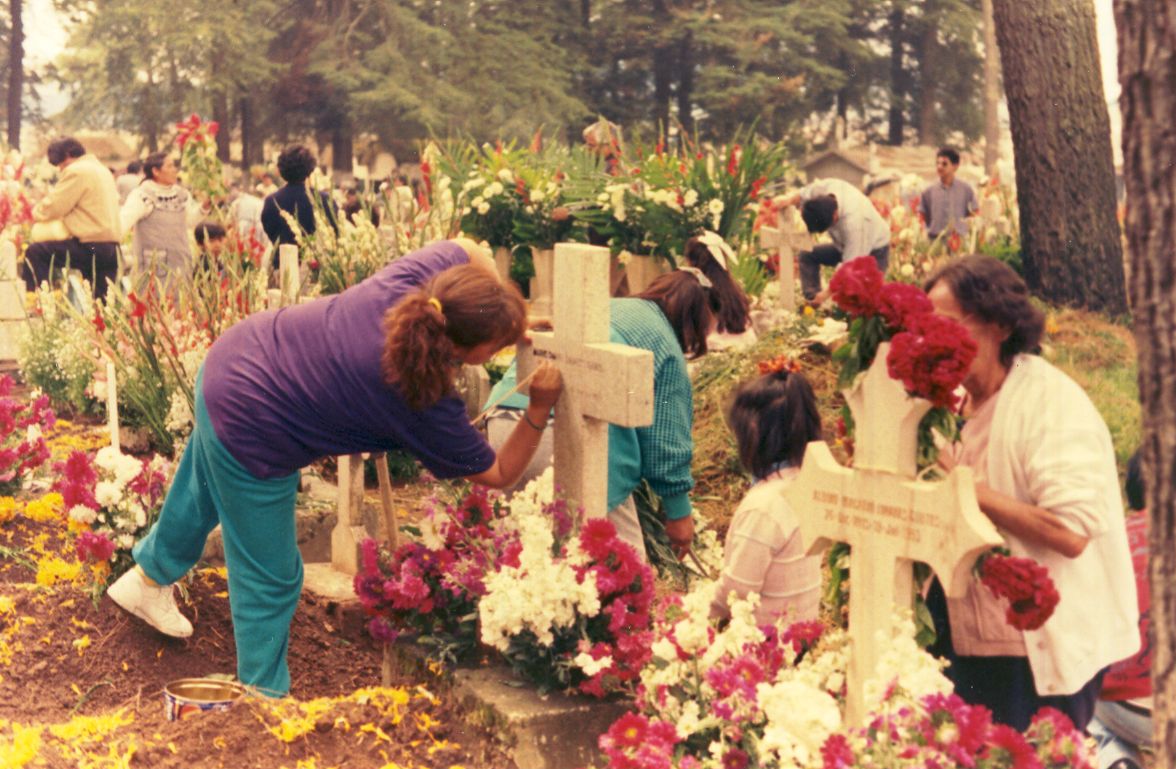
One of the trips I look forward to the most in the future is visiting Mexico during their annual "Day of the Dead" festival (click on the photo above), because I think it's an absolutely beautiful tradition to keep. Native Americans* often have different funerary practices than European Americans, depending on the tribe and its geography. Out west, people were wrapped in several layers of decorative blankets, placed high in treetops on secured wooden platforms, and visited after the body was completely dessicated so their bones could be wiped clean, to be put back within a smaller bundle in a ritualistic design**.

I appreciate their traditions for representing a more mature attitude towards life and death. We are born, we live, and we die. Simple as that, or not, depending on your amount of life strife. But, wouldn't it be comforting to know that the children you gave birth to (and their children's children) came back to visit your grave in memorial every year, decorating the site with beautiful artwork made from the traditional designs of your culture? They would be the people who gently unwrap your bones, tucking you back into a fresh bundle, keeping your resting place neat and tidy. 

It's so cheerful, isn't it? Your family plot becomes a place people look forward to visiting, by celebrating your life (and theirs) eating and drinking the same foods you enjoyed during your life. It seems like such a loving thing to do, in contrast to our colder American burials, as performances of grief and mourning that often lack the real heart and soul of your loved one and their life. My grandparents were such fun people for me to be around, but their brood is most definitely not: there's nothing to be had for me by spending time with them, whether its over a burial mound or anywhere else, for that matter.

Then, why would I do something so intimate as grieve with them? They don't understand life! Would they understand death any better? They don't get it, any of it. I understand that life and death is a process because I was taught that and I've also experienced it, but I'm also the best student my family has ever produced. I'd rather be on my own, than suffer through a bad death with a bunch of people who lack feelings and emotions. Do you know what I mean? We need to change the way we feel about life before we can conquer death, or life-after-death, as part of G-d's eternal promise to us for an everlasting reality. That's the day I'm looking forward to: the greatest holiday of all time. ¡Salud!

*   https://en.wikipedia.org/wiki/Burial_Ridge
** https://en.wikipedia.org/wiki/List_of_prehistoric_sites_in_Colorado


Thursday, November 3, 2011

The Last Days of Shishmaref


Like so many people this time of year, I've been dragging around town half-heartedly doing errands, in an effort to get my chores done before a full-blown cold settles in. I'm really tired, necessitating lots of tea, napping, and the elimination of dairy products from my diet, at the suggestion of a local barista and my doctor alike. While I rest up with that run-down feeling, I've been catching up on t.v. with a few DVDs from the library.

"The Last Days of Shishmaref", a documentary about a region of Alaska and the native Eskimo people who live a traditional lifestyle there, is a visually arresting movie. It's wild America at its most beautiful.

The climate is quickly changing in a warming trend that's been dramatically effecting the seasons for a long time now, with the polar ice caps melting to catastrophic effect. Bearing the brunt of this global impact are the Inupiaq people, who have relied upon seasonality to provide for their families for over 4,000 years.

Worsening storms from enormous ice melts and longer warm seasons have caused so much damage to their small island, that the tribe has already moved their homes back from the shoreline once. Sadly, that's not enough to save it. Shishmaref will soon be totally under water. 

The good news is that part of the mainland has been reclaimed for their tribe. They will still have their ancestral hunting grounds and fishing territories, though serious adjustments will be made by their moving. They have been an island people for a very long time.

While the wheels of government adjust slowly to our everday realities, the fact is this: relocation is extremely costly to people and the environment. The move for Shishmaref costs about $186 million, money that could have been spent on sustainable, eco-friendly tenchonlogies a long time ago. What say we make the wheels of change move a little quicker? The indigenous people of the Americas were here first. It's only fair: http://www.thelastdaysofshishmaref.com/shishmaref3/cms/cms_module/index.php


In this global world we live in, we are all neighbors.