Showing posts with label The Silent Generation. Show all posts

Thursday, December 15, 2016

The Etruscans


My best friends’ father Charles was her first inspiration for studying history, though he'd pursued a psychology degree instead, which got him a stressful social workers’ job in the Bronx during the height of the citys’ struggle with crack cocaine in the 70s and 80s. After his idealistic post-college stint in the Peace Corps, a time of hippie experimentation with native sweat lodges and hallucinogenic trips on peyote buttons in the Mexican desert, he struggled to find meaning and equilibrium among the hard-hit minorities who came to his office for help. 

Instead, he found bitterness and a lack of understanding that ingrained in him a casual prejudice fueled by his own inertia and passionless marriage. It was hard for us to watch her hip, smart, educated parents from the city, the first to attend college in their families, go down so deeply into alcoholism and madness, but like so many of their "silent generation", they refused to admit the seriousness of their illnesses to anyone, so they could condescend to the people stuck in the ghetto, who they wanted to see as having so much less than us.

We'd find him puttering in his garage during summer breaks from school, sweating in the heat and avoiding his wife inside the house. He'd made a little workshop for himself there, so he could paint tiny military figurines in exacting period detail, while he expounded upon his favorite topics like the Etruscans, always delivered in the exact same way: "Girls, have I ever told you about the ancient Etruscans? They were a very advanced civilization that pre-dated the Greco-Roman time period. Most people don't know that." Ah, okay. It was better than the usual power struggles between her parents, with their tense silences and chain-smoking drunks that'd go on for days. We'd go on beer and cigarette runs for them just to get the fuck out of the house.

With a little encouragement, her father would go on to describe Etruscan burial mounds and their sophisticated societal hierarchy that would inform and inspire the later governments of the much more famous Greco-Romans. We found it touching that he clung to Italy's historical underdogs out of some sense of loyalty to them and their almost-forgotten world, like any real historian would. Though her parents never made it out of their personal struggles with addiction and mental illness, I can still see him in my mind's eye working in his garage, at a time when the whole world was opening up to us from between the pages of our college textbooks, in the cold mountains of an upstate New York winter. Ta, Charles. Thanks on that. 


Thursday, November 3, 2016

Slackers


All of my early life, I was told that I was sloppy, lazy, careless, and a pig, without actually being any of those things. The name-calling was used by my parents to hide their real agenda: using children as a workforce to make their lives easier. It was simple to them. Why else were we born? I was talking to my friend Katy today (while getting a haircut from her) about wild American politics, because the Russia she's from is so very different from our world here. But, times do change. We no longer allow children to get work permits from their elementary school principals for a paper route like they did when I was a kid, nor do we ask children to bear adult economic burdens by letting them leave school, like my grandparents had to do during The Great Depression.

But, my parents didn't have that to deal with. My mom had one (ONE!) part-time job during school wrapping Christmas presents at a department store (and that was only seasonal) because she complained bitterly about the homemade food my grandparents served her, so they told her to go out and get a job and go buy her own food. They were great cooks, by the way. My dad always complained about his terrible childhood and crippling poverty...with my nursing assistant grandmother and medallion-owning grandfather with his own taxi. 

It never added up to their self-described portraits of severe deprivation that they continually tried to sell us as a reason for their abuses against us, especially since I grew up with my maternal grandparents a mere 5-minute drive away. Sometimes the truth could be had for a 30 second phone conversation with them, too. Into this toxic cocktail came the Baby Boomer hangover about "free" everything without any work required (just like life!) that lasted for a couple of years in the 60s when they were teenage drop-outs, followed by my parents Silent Generation of rabid consumer fantasies fueled by massive t.v. consumption, where anything can be bought for a price including happiness, again, just like real life!

Any GenX'er wanting to make it had to give lip service to a bunch of half-baked stoner ideas from the late 60s, or subliminally gay "buddy" Western movies from the repressed and deeply closeted 50s, with neither being the culturally correct stance to have. People were totally full of shit all around us, every single day, parroting lines from t.v. commercials for dish soap like a long lost savior had just given them the winning golden ticket to a better life. It was fucking insane. No one told the truth anymore, because you couldn't make money that way.

Just like fashion magazines pushed the same vapid blond as their falsely generic ideal about "American" beauty so, too, did movies "toe the line" creatively by flattering fragile Baby Boomer egos with their hugely overblown senses of self (derived mostly commercially and economically), by rehashing the old media term "slacker" as a deliberate mischaracterization of GenerationX, the same way marijuana was demonized for being dark and mad. It had absolutely no resemblance to the blue collar roots that me and my friends had coming up from the city, with some of us from the projects, while working 3 part-time jobs just to get to school.

Of course, that's the plan behind any kind of serious bullying: make up a falsehood passed off as the truth, spread it around, and then sit back to enjoy the show. While some Ritalin-dosed muthafucka easily got funding and industry backing in the early 90s to make a really bad movie about arty assholes in Austin*, the rest  of us did what every real working artist does: we got a good night's sleep so we could wake up and go to work again, day after day after day. Not the exactly same picture as Hollywood's version, is it? It's not mine, either.


* https://en.m.wikipedia.org/wiki/Slacker_(film)


Wednesday, July 27, 2016

Shock to the Heart


Back in the day, we used to say lines from the old show "Sanford and Son" to each other that we had memorized by heart (https://en.wikipedia.org/wiki/Sanford_and_Son), having heard the same lines over and over again, like our parents compulsive "jokes" that were often told in times of stress and/or drunkenness, when they didn't know how to fill in conversational spaces with other humans correctly. 

"Old Man Sanford" would clutch his heart in mock anguish to deliver the well-honed line to his son that he was "on his way home" to see "Ouisie", his wife who'd passed on already, because he was "havin' the big one" that was so often threatened on the show but never actually came about. Oh...so, it's just a lie, then. We kinda felt gypped by the lack of "sudden death" action on t.v., like the nonsense our hysterical parents would blab out loud that was even less funnier than the sitcom stuff repeated for years on t.v. Yeah, sure. I know this line.

It became symptomatic of the psychological distress we'd see in the world that was the response of someone who uses their medical condition(s) as a manipulative tool(s) to get out of work, or human discourse, church on Sunday, or family visits. For a people who felt bereft of power, my parents and their friends employed a handy toolkit for the insane that included veiled threats (and not-so-veiled threats) that they often combine(d) with violent cursing and escalating acts of physical violence, which, rather than convincing us to obey their demands, made us want to stay even further away from their trouble spots. For them, their sickness became weapons for gaining leverage in the home and at work, with varying degrees of effectiveness.

It was silly and wasteful, but so were/are our parents, accustomed as they were to an ever-booming economy fueled through the machines of war. We wanted something better. We wanted something more from them and society, and the world at large. We wanted actual communication over the trite tricks brought on by so much t.v. viewing for the compulsively-addicted brain, followed by periods of paranoid non-engagements that could last just as long as their patterned routines that they inserted in lieu of actual thought. We talked to each other as a social group, and we wanted to see real conversation brought back, egged on as it was by the "shock" tactics of our disc jockeys and talk show hosts. A lot of it was the same old bullshit, but occasionally we broke through the static with our own hard work. See? Repetition does bear results, and I can talk about it at length, too.  
How's that for power tripping?


Friday, July 15, 2016

Mad Man


https://upload.wikimedia.org/wikipedia/en/9/90/Mad_Men_Season_1%2C_promotional_poster.jpg


My dad absolutely hated working in the city, even though he'd beat the odds against poverty and a "lowly" ethnic background with a supposed "mixed birth" in his ancestry that plagued him wherever he went, because that's the reaction his last name elicits. He was been born in Rhode Island before moving to a farm in Maine with a little red schoolhouse down the road apiece, which lent an idyllic air to the surrounding countryside, if not his actual home rife with spats of violence and severe alcoholism. His family sold the farm and moved to Bedford-Stuyvesant in Brooklyn, which probably seems to you like the cruelest joke to be played against a young boy, and you'd be right.

He never really got over the change of pace they'd made to be closer to the family who'd help a single mother like my grandmother, even though every place he lived afterwards would never quite measure up to our fair city, because he retained a grudge against New York City from the strife he endured. I totally understood. I hated Rockland County as a kid, mostly because of the viciously competitive yentas of New City who liked to constantly remind us—through their spoiled brats at school—that we were considered lower than them, they who were destined to become doctors and layers, and failing that, dentists and chiropractors. They'd threaten to sue.

Unlike other typical "white" childhoods, we never really passed muster the way outsiders might think we did. Yeah, you had your definite skin tone and features that placed you squarely within a solid group of other "minorities" (and that status has always been highly suspect to me, though not the subsequent abuse and racism after many Americans emigrated, whether voluntary or not), because we still proudly carried our last names and distinctive features. It don't pass notice 'round the way, trust on that, and it always starts out the same way, too, albeit deceptively innocently: "Oh, is your last name 'French'?", in a pseudo-airy style. Of course, they don't really want to recognize European conquerors and other unwanted invaders to someone like me.

Then, they (my purposefully distracted audience) pretend that our real ethnic story is so hard to understand (or dull), that it's quickly followed by theirs. My dad had trouble from the very beginning in the city, because everything about him was wrong. He wasn't Italian, or Irish, or Puerto Rican, or black, which are much easier ethnics for average urban Americans to assimilate.

It became the first conversation that our attackers learned to avoid with us, which they would only signal when hard-pressed with something vague like, "there's something 'different' about you", becoming white code for "I know you're better than me and I'm a fuck-up, but I'm crazy, so if I admit you that to you, then you 'own' me". Well, yeah, kinda. By my rights. The thing is, me and my friends all had it rough, and we couldn't explain our parents crazy on just some po' oppressed n@gro story, feel me? We were all considered lowly downtrodden ethnics, be it a loud Dominican, or drunk Irish, or a greasy guinea (all those "dark" kids runnin' around yellin', ugh...Catholics), or Africans, or my "Half Breed" cousins.

It made him want to reinvent himself at every opportunity, and combined with his learning difficulties and sometimes serious cognitive impairments, it left him feeling extremely prone. He told me half-truths about joining the navy at 17 because his home life was "so bad", when in truth, his drunk dad had left many years ago, to be replaced by my loving, gentle Italian-American grandfather who stayed with my grandmother for the rest of her life. His cousin (also a serious drunk) told me he was on the reserve list before he was enlisted, and I knew what that meant. My dad doesn't make the cut right away, or sometimes at all, which he hides out of an embarrassment and fear that never seems to go away, no matter how much money he has.

He also told me that he was in a gang, and the way my dad gambles and works the pool table tells me the rest of the story about his greaser past as a small-time hood. Like his papa, his mama probably pushed him into the military, in yet another attempt to dry up one of her folk from dying, but unfortunately the military does cure disease. He said his "best friend" was electrocuted for murder as a teen, after a knife fight in an alley went wrong. Like most of his family, it was fucking crazy enough to be true, because we have/had hard-bitten convicts doing serious time in my family. It might be right.

And so, he did what millions of American men have done, since the start of our military: he flipped money from the G.I. Bill into an education, because he found a real mentor in his Naval C.O. He hated military life, but he loved the results, so he set out to remake himself into an American ideal, like the old black-and-white movies he used to escape a rough home life or the troubles he causes, preferring to sink into a dark movie theater cooled with air conditioning that he didn't have at home, so he could check out of reality for awhile. He always carries around this deep sense of need wherever he goes, you know what I mean? Like, a deep sadness settles over him and whatever evil he thinks he's done that he can't quite recover from in a really honest way. It may not even be real, the depth of his pain, but in his mind, it is.

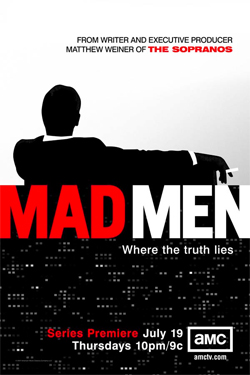
It didn't really hit home for me until I saw the first few episodes of the t.v. show "Mad Men", a show about so many striving city people of his generation looking to ditch their identities for fake ones that Madison Avenue churned out for them in a siren song. It was alluring for them, escaping a reality that hated them for who they were. Everyone and everything had to change to suit some commercial sameness. After watching every episode, I felt an pit in my stomach that was backed up by my mom's impressions, too, and she totally sucks at media. "Yeah", she said to me, "that's exactly what it felt like back then." She paused, "G-d, what are horrible time it was." And it was. People hid anything that they thought was "bad", or less likely to sell in a corporate marketplace, like their homosexuality or their ethnic roots, to be white-washed with the latest lead-based paint or cosmetics that passed FDA approval.

I remembered it in bursts during my own bus commutes, battling homelessness and starvation; his pressing of hot spoons in the mornings to clear up sinuses he always complained were made worse with stress, his heating pad treatments and cookie binges that left him prone on the sofa while we attended church services with our mother. When he did attend, he never mouthed any of the words to our liturgical services, before he finally left the faith for an easier version that he was raised to believe was utter blasphemy in its creation against the church of Jesus Christ. Some protest.

That was just his "downtime". He'd take us into the office for weekends when my mother didn't want us around, so me and my brother could draw pictures on old office papers and eat sugar cubes from the kitchenette area for coffee breaks taken during the work week, after we'd done a thorough search of the office drawers for candy and gum. He got his suits custom-tailored at a Wallach's store in the old Nanuet Mall by this short Jewish guy with a measuring tape around his neck who had his measurements on an index card in the back of the store. I loved it, because it was like attending an exclusive gentleman's club, with expensively-tufted leather chairs and the smell of good fabric hanging on every rack.

He hated every minute of the weird head games and strange office politics, even as he was complicit in the same type of crimes against the public trust, through every deal he'd do that put him deeper into a moral hole that followed him before and after the city that gave him his first family. I felt (and still feel) sad for the lost boy he is, even as I hate(d) his abuses against us. May this weekend, and every weekend after, find him peace, as well as for all the sufferers of the unfair, the unjust, the sick, and the poor of spirit. May they inherit the earth through their humility. This mother knows it firsthand.