Showing posts with label Ethnic Cleansing. Show all posts

Thursday, June 15, 2017

Narc


Copping weed in a sleepy suburb that's always been more country than city was almost impossible for me growing up, the city even harder for me because of my clean-cut good looks. I joked with my buddies at the corner store that no one even wanted to stand near me during our town St. Pat's Parade because (according to one of them), "You look like a cop!" If being a detective means I'm aware of open container laws, cognizant of my surroundings, and respectful of my neighbors even during a daytime "beer buzz" by still recycling appropriately, then I'm the Sheriff of this here town.

After being rebuffed by do-ragged bangers hanging curbside in the tough gang towns of Rockland run by drug dealers during the 80s, me and my friends turned to the city for our teenage rebellion, but I was quickly becoming a curse to them in their nefarious deeds, in an anti-anti-establishment cancel out. We'd cut class to take the city bus to buy weed near Central Park, only to be ID'ed by a beat cop who laughed at my underage library card (the only ID I had), throwing our small dime bag into the trash with the order to take the first bus back home, which we did, after debating about trying to find the little baggie in the garbage pail.

It didn't end there, either. Me and my friend who'd emigrated from Ghana as a girl tried hanging out in her family neighborhoods of Harlem and Downtown Brooklyn, but without my Hispanic home-girl outfit from back in the day (slicked-back ponytail that made my hair look darker, bright red lipstick, big hoop earrings, and tight jeans), the people in those 'hoods treated me like an outcast on my own native soil, to be shunned and feared as a girl-child not of their kind. 

The pinnacle of my brief career as a country criminal officially ended in the back of a Harlem liquor store with my girl, Donnel. She'd said she bought weed from the guy behind the plexi-glass window with a pull-out money drawer before, so it should be no problem. We laughed on the street before going in that he'd be afraid of me as a "white girl", which was the only way to explain my presence in certain parts of New York City that hoped they'd killed or frightened off the natives a long time ago. I mean, I look this way at 47; you can see from my photos how youthful I've always been.

And it's true; there's a purity and wholesomeness to me that doesn't go away with alcohol, or pot, or cigarettes, or junk food, because I don't let it. I want to live, even in the chaos of this world. And so, with one quick walk to the back of a ghetto liquor store, the nervous demeanor of your average black man livin' on my mean streets told me everything I needed to know about what my choices would be. In his wide-eyed stare, I immediately knew what side of the line that he'd drawn between us I stood on, and it was with the good guys.

"Uh uh. I ain't sellin' to huh." My friend improvised like the slick con she can be, rolling her eyes at him. "Oh, come on, man! I've bought from you before, no problem!" He wasn't buyin' it. "She a cop! You a narc?" He asked me flat out, but my friend pushed me aside. "Look at her! When was the last time you sold weed to a 15 year-old narc?!" And it was pretty incredulous, his irrational fear about a baby-faced teenage girl. But, just like that, I knew it in my heart, that this native New York girl wan't no criminal, and I never would be. As we left the store empty-handed, I could feel my less-principled friend cutting ties with me mentally, diverging in the opposite direction, because (s)he was right about me. I'm no fucking criminal. I AM THE LAW.

Thursday, April 28, 2016

Exiled on Main Street


Being an exile in your own land is a strange experience. People descended from more recent émigrés to our beautiful land here don't know (or understand) my last name. I've already had to spell it out twice today while explaining its long heritage, in this small hamlet that is rather fluent in "immigrant" (as is most of the New York area), so you can imagine what the rest of the country (and by extension, the world) is like for us. We need better publicity!

The land of "Acadia" pre-dates the creation of the current borders that divide the United States and Canada (https://en.wikipedia.org/wiki/Acadia), much like my sophisticated Norman ancestors (pre-dated by my ancient Greco/Roman/Mesopotamian ones: https://en.wikipedia.org/wiki/Greco-Roman_world) dominated Europe through trade and their cultured abilities to connect with the local people around them, wherever there may be around the globe, much like I do today. That does not mean that I have that state of awareness reflected back to me often, resulting in my infamously patient temperament I learned to develop, lovingly guided by my grandparents.

"You're gonna learn all about patience now!", was something my grandmother told me more than once, in recognition of those greater gifts that need much more extensive (and slower) explanation to the crowd gathered around me. Leadership is not easy, and like any great educator, repetition is a big part of our toolkit. Publishing is rife with trends in the human experience that need more than one or two nuanced marketing niches to accurately describe content to an interested audience, and that could be just a single genre.

We like to research by looking at a subject from all angles, then pick the entry point we think you can plug into the easiest, so as to enhance your comprehension as you move forward, with or without us. But, how do you do that with a people who were cast out, dispersed, and strewn around so as to prevent a congregation of support from building a case for us that we were supposed to make for you? You're reading it now, and how many years has it been? It seems backwards, doesn't it? That's how long it's taken for me to unfold our red carpet ride through history for you, with its complexities and various moving parts.

Today I am grateful to have this public forum that reintroduces you back to us as a concept in these modern times as your loving ancestors; marginalized, impoverished, and beset as we have been. Rest assured, my dear majority, we have always been here for you. Sometimes a minority group is small for its precious rarity, not for its insular exclusion, and so I ask you to rethink your rigidly guarded boundaries done quickly and incorrectly, to be carefully redrawn by the people who came here to lead the way back home, not block the passage of others seeking to enter. Are you worthy of us? Are you worthy of Acadia? I hope so, because we're here to stay. That's our “forever” promise to you, as our beloved descendants.

∞
∞


Monday, December 14, 2015

Bodega


Bill Clinton was considered the first "black" American president because he came from the lowbrow South (earning him the name "Bubba"), with a crazy-ignorant mama and an alcoholic brother who's in-and-out of jail, before, during, and after his Presidency. It was something that people like us from the 'hood could understand, with a huge sigh of relief. It certainly made a lot of sense to me as I entered the Ivy League, because I'd never met that many fucked-up rich white kids in my life. I wasn't "out" as Acadian, because I was close enough to Canada that a New Englander with an axe to grind could destroy me through bias against French-Canadians as the key to my college career ruination, which is exactly why my people were mass murdered centuries prior: for a supposedly shameful act of love between a European man and an Indian squaw with offspring so defying beautiful, that many of us are still hunted in envious sport.

Think I'm exaggerating? The Canadian government has just officially recognized the "ethnic cleansing" of Acadian Métis (or "Aboriginals", as they derisively insist in calling all natives  common to the Americas), let alone admit to the child abduction and rape that was a common practice for wealthy Europeans hoping to wipe out key witnesses to their crimes. It's not unlike the United State's checkered past with it's own native peoples, that a President like Barack Obama has been actively working to address with Sally Jewell, the Secretary for our Department of the Interior, by taking meetings with tribal elders to heal the hurts here, from way back when.

Instead, I stuck to what I thought were the relatively easy immigrant-bias experiences of my maternal Irish and Italian forefathers, but I was wrong on those accounts, too. I was attacked in an advanced photography class for daring to refer to me and my ConEd grandfather as "working class," by a British git who thought he could get away with it, and he was right. The teacher was a grad student I knew, who chose to smooth over my revelations with an "across the pond" type of cultural misappropriation that was grossly ignorant, preferring to refer to their welfare childhoods as much more severe in poverty and bias than anything we could have possibly have endured in New York City, paved with gold as the myths were.

They co-opted my conversation (which would have opened the door to further inquiry with the mostly New England student body present in that class) between the two of them; he as a poor boy from Mississippi with torn jeans he couldn't afford to fix (?), and he with council flats and a company coal-mining dad. Both were older than me, too, and so it was easy for them to swipe my background to the side successfully, as having the most hurts from the working class, and it certainly didn't end there.

In the tony Painting Department (I was in the relatively "working class" major of Illustration so that I could get a job after graduating which I did. I was also the first in my graduating class to obtain a full-time job with "health benefits", too! I also had 3-4 part-time jobs while attending RISD, in stark contrast to the po' white boys who were on scholarship just for singin' their song), and I was openly laughed at by the slightly dykey, arty, rich white lady with the short, mousy-brown haircut and the "John Lennon glasses" for daring to make a painting about my Irish great-grandfather's work on the iron and copper work around New York City. When I asked her why, she just huffed at me, "I don't know 'why'...it's just so...so...so...funny!", because she'd never seen a project like that before.

Me and another kid from New York (a rich Jewish Long Islander in school for film-making, but with a populist bent that was extremely unfavorable at the time) decided to prank her for being a delusional rich asshole with no sense of reality, but that's a story for another day. Suffice to say, my working class housemate Riddell helped me forge the copper frame for the piece, and I used copper wire to sew the denim to the frame as a canvas, direct references to his bridge-building and metal shop-work (he was a master craftsman who made a copper version of "The Last Supper" that still hangs in my mother's place, and which I cleaned myself many times, so as to carefully note the finesse and detail attached to it as being very finely done), as direct references to our "working class" history that couldn't be denied, and that was just the easy Irish stuff from a century ago. I could not have built with my current lexicon the full story of my people, built on the backs of murder, rape, and theft as they are.

I ran up against white bias and European prejudices all the time, in almost every critique I had in studio, or outside-of-class social encounters. Out as an "Indian"? Do you know what they did (do) to us?! It was a family secret that had no time during my tenure there, fraught as it was with all the above reasons I just noted, easily observed as they were by my friends and classmates. I barely made it out of there with my life, as a crime victim of robbery while working a job, and "blacklisted" by rich profs afraid of losing their tenure, as they lost their minds at our expense. You see, "The Ivory Tower" is only good as an edifice if you uphold their traditionally white WASPy values tied to lip-service and exclusion, not by extolling the real, true, expat rebellion with a long-storied past, as actual descendants of the "Daughters (and Sons) of the Revolution" like I am through my paternal grandmother's line (http://www.dar.org/). It was too much for their warped, privileged minds to bear.

It was in this way that I became infamous as the first openly "black" student at R.I.S.D., which I didn't really know at the time, because I always had three or four part-time jobs and a full studio schedule, which is unheard of among the plush upper crust set who struggle to read and write, like the illiterate cast-offs from wealthy families who were in the majority against me and my offensively real New York roots. I could get away with "ethnicity" if I did phony displays of African Dance (like my friend Riddell did), because the museum wanted African artifacts and a faux arty display would play well overseas with fancy donors, not with actually beleaguered native Americans hip to the game. Money came untied with that kind of awareness.

And so I found myself in a car ride with my punk rock housemate Sue and her weird hippie friend Ellie, who I naturally thought was a rich Jewish girl from Michigan, because she had all the superior airs typical of the boho "Trustafarian" set with no real talent, but who liked to spend time in academia as pretentious intellectuals. She never really liked me, open as I was about my ethnic roots (as much as I could get away with, alone and unsupported as I was), and it wasn't until many years later that I figured out the specifics as to why. I knew she hated "pretty girls" (not that I thought of myself, even as people openly gape and stare at me). I thought she was embarrassed because she and I had to take basic drawing class (with my mentor, Lenny Long), because we were really far behind the older and richer matriculated students.

It didn't bother me, especially since Lenny had gotten to me at my core (he's from New York), by giving me an infamous speech about not letting "them:" win by making me quit, and it worked because I got angry enough to channel it into energy I could use, like fighting does for me as a warrior), plus I also knew that I had the deck stacked incorrectly against me, through no fault of my own. So? Do the work, he said to me, and that's what I did. That's what real working class kids from New York do, but Ellie didn't know that. I knew she was a former forest ranger in Oregon during the Mt. Saint Helen explosion, alone like a lot of anti-social hippies are in a fire tower for many months on end. 

She had that typical awkwardness about her, often wearing the usual Birkenstock-with-socks hippie garb that marks the warm weather kind who does not cotton to our climate well, because they "winter" in warmer climes. She also had the type of curl that we call here on the East Coast a "frazzled-haired yenta" and her last name was "Leon", a new Jewish name that easily could've been anglicized years ago for the MidWest, from what might be the original Leonberg(er), like they used to do with newly-arrived immigrants to Ellis Island, which coincidentally was the photo essay my first photography teacher from S.U.N.Y. had been assigned to through a grant from New York State: to document the renovations of Ellis Island in New York. She also told me back then that I could get into R.I.S.D., if she got into Yale as an Italian-American. "You can do anything", she told me. Thank you for that.

We were on a beer outing that went comically awry one afternoon, for reasons that puzzled me for many years. As we drove up to a shady-looking joint, I immediately balked about going inside to get beer for our group. "Uh uh," I said, "I'm not going into one of those places." Ellie turned to me in the backseat, with her childishly barretted hair in plain metal clips, and the de rigeur makeup-less face that are necessary components for the rich hippie crowd, "What do you mean 'that kind of place?'" I knew I said something wrong, but I was only 21 and living outside of New York for the first time, unlike my housemate Sue and her friend Ellie, both women in their 30s on their 2nd, 3rd, and 4th careers and educations. "That's a bodega!", I giggled slightly like she was a dimwit, or she had deliberately set a trap for me, and it was the latter. "Yeah, a bodega.", she huffed impatiently back at me. Uh, okay. Poor thing. "Yeah! That's a Puerto-Rican joint in New York." She turned up her nose at me, turning slightly in direction without looking at me in the backseat of their car, "And what exactly are 'those types' of places?", like a sour-faced teacher calling on the retard kid who never knows the answer.

"You know!", at this point I was the exasperated one. Where's she from, yo? "A Puerto Rican grocery store!" She sat still, so I went on, "See those 'booty' posters in the window", and I pointed to the ass-shot beer posters typical for a Hispanic deli in the 'hood. "They always have those in the window". She huffed again, "They?"...uh, yeah..."THEY always have those?!", she continued, working up steam to make some unknown point, "I'll have you know that I'm a 'Catalan'!!" Me and my friend Sue from Boston waited for her to finish her sentence...yeah...and? So...? "Tsk", she tsked-tsked fussily, still in a huff. "I'll have you know I'm a Catalan Spaniard* from my father's line." Ohhhh! Whew! What a relief. That's it? Yeah, bitch. We know! You're a European white girl, esse. I laughed, took their money, got out the back of their car, and bought us all beer for our party back at the old house on Benefit Street.

Shit, that bitch just wanted us to know that she was better than us. Just another day at R.I.S.D. for me, and then I didn't really think about her unless I made contact with my former housemate, Sue. How come she never reconnected with the rest of our transfer group? And then, a couple of weeks ago, I got an email from Sue that finally cleared it all up for me. She was more than embarrassed by her time at R.I.S.D.; she was mortified. You see, Sue went to see Ellie in Michigan, her home state, and on that trip she finally learned her really shameful secret, the one that she really didn't want us to know about back then (besides some banal European history) and that's this: she's the daughter of a well-known and much more successful illustrator father that she could never compete with or keep up with, and that was why she picked on the one "negro" she felt she could safely get away with picking on: me. And she did get away with it, until today.


This one's for you today, Sue. Long may truth and freedom ring with a loud "Yanqui"** rebel yell! We know who we are, girl, and we are revolutionary. Keep on shining, my true punk-rock friend. We tore it up rough enough to scare 'em, didn't we? Yes, we did.

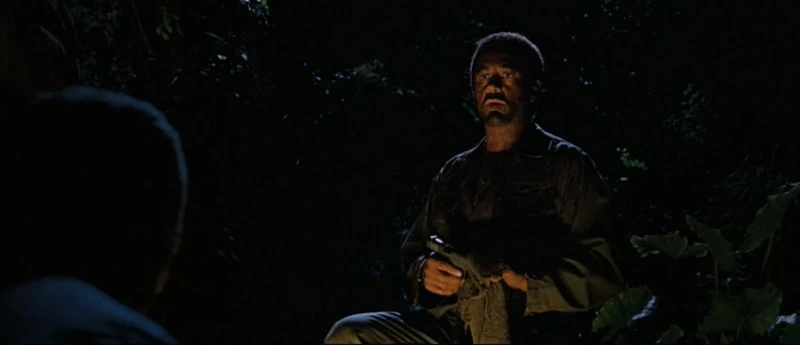
http://vignette4.wikia.nocookie.net/tropicthunder/images/7/77/Osiris_campfire.jpg/revision/latest?cb=20120826164857
Kirk Lazarus: https://en.wikipedia.org/wiki/Tropic_Thunder


* https://en.wikipedia.org/wiki/Catalan_language
 ** https://en.wiktionary.org/wiki/yanqui

Wednesday, September 30, 2015

Rock you like a hurricane


http://www.himandus.net/hofh/chauvin/richard/map_cbc_acadian_resettlement_1764.gif
http://www.himandus.net/hofh/chauvin/richard/richard_00_acadian_history.html

I planned on writing a piece today about minority culture, when a casual conversation with my neighbor directed me towards another key issue affecting impoverished Americans that's a tie-in with today's "Hurricane Joachim" conditions, and that is this: flooding. It's no secret to my Acadian, Cajun, and Creole peoples that oppressed minorities who threaten the status quo were (are) pushed into marshlands and swamps (what up, Zydeco fans?), conveniently "resettled" during occupational wars with not-so-hidden agendas. Richly fertile island nations with beautifully exotic women were suspiciously targeted the most often. 

To this day, "white" Canada disparagingly refers to any native person as an "Aboriginal", in a clear attempt to marginalize their First Nation status by wrongly placing them in the same category as the people of Australia, who are seen as less than attractive by the European Penal Colonists sent there without choice. Obviously, each human tribe on Planet Earth has a range of beauty from the ugly to the more comely, but it is no secret (see me in pics) that the Métis figured something out: French (or Scotch/Irish) guy mates with squaw = an "OMIGOD, how do I get my hands on that?!" level of attractiveness that my sweet Norman Barese grandmother from the Abruzzi region of Italy called "Oo la la!" in a loud voice whenever she thought it was wise to remind her family about me and my key "factor", and she was never wrong about anything. Like, ever.

The Canadian government recently officially recognized that the enforced separation, murder, and ethnic cleansing of Acadian Métis was "unfortunate", which is kind of like saying that the Serbian Croatian War was "bad". Yeah, you think? Ripping families apart based on eye color has become such a taboo subject in my culture, that deeply ingrained prejudices about it remain in place to this day. My Québécois/Irish-American college boyfriend from Bay Ridge, Brooklyn told me a few times that he had qualms about my "marriageability" because I have brown eyes (strikingly coal-black eyes are a trademark Métis feature) and he has blue eyes, and, ahem, you know, well, maybe he wanted blue-eyed children. Me, looking like what you know to be true, and he is no supermodel. It was a petty little head game he played with me to parlay my supposed insecurities about my looks into his hands, which...well, you see where I'm at with him today. Nowheresville.

Race continues to define the descendants of a culture that took American ideals at face value when it came to openly assimilating different cultures. French with Africaine? No problem: you Creole now. European with a Native? Okay, we are Métis. Ditto with your Irish, Scottish, British, and Dutch ancestors with us. Now you tribe, too. Twenty-five percent is all you typically need to get in, barring any serious medical conditions like violently anti-social paranoid schizophrenia (which is kind of a "no-no" in any human community), and we just might let you in for life. All we ask is that you accept my brother and my sister, who may or may not share eye color or the exact same skin tone, but we have a wide range. You follow me here? 

The Acadian Deportation (Le Grand Dérangement) is exactly what got you stranded in an area below sea level, ami. Homeboy, you sinkin' in Red Hook right now ("Hoek" in Dutch, New Amsterdam) because they don't like you and your kind, especially if you get along well with your neighbor, who may or may not be the same color as you. Ya dig? You're the "problem" they want gone. "But, who exactly is 'they'"? "Who", indeed. Now you're asking the right questions. See you on the other side, friends. And take swimmin' lessons in the hood, mes Cajuns et Creoles. Hurricane season is officially here.


https://en.wikipedia.org/wiki/Effects_of_Hurricane_Katrina_in_New_Orleans 

http://portsidetanker.blogspot.com/2013/02/red-hook-sandy-surge-map.html 

https://umaine.edu/canam/publications/st-croix/acadian-deportation-migration-resettlement/ 


Wednesday, July 29, 2015

Trail of Tears


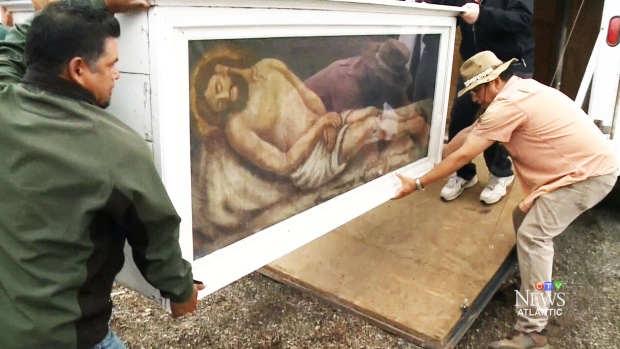
Anciet alter returned to Cape Breton church
http://bit.ly/1OtyMcW

I heard about a lot of holocausts growing up in the New York area: the killings during World War II (naturally), which led to my schoolmate's telling of her family's Armenian genocide, but the only story of mine I knew was in a book, albeit infamous epic form*. The grandeur and longing for home and love is something that never leaves you, even when my family left it out of family gatherings, the way my parents hinted at darker histories by naming our cousins "Dark Irish"; an apt way to describe the twin horrors of deliberate starvation through The Potato Famine** in Ireland, and the marking of Métis children by the darker color of their eyes, which must have sank a pit the size of the Atlantic Ocean in both of my parents' stomachs. Who would see it? Would they know the story? Who can they tell the knowing of it all? What would happen to us, in any time period, given the collected badness of centuries past?

And so they sank it way down deep below, like a hidden headdress fitted for a beautiful little girl, or a pair of handmade Baptismal moccasins that may be tucked away forever; two sharp shooting pains forever felt by burying it within, like a treasure chest to be discovered by someone strong enough to survive its' telling. And so I leave it to you to gather up all of our fallen tears, on a trail that leads the way back home, through a river journey I can feel like the wetness shed by the cries of so many parents who felt their beloved ripped out of their arms, in an act of murder so painful***, I can't really wrap my entire consciousness around it, let alone take on the pain of a mother and father who did nothing wrong in G-d's eyes but love each other willingly and with open hearts (http://historynewsnetwork.org/article/11204).

Today I give thanks to the loving qualities we have present in our free society, ones that many people have fought and died for. May we love each other always, with gladness in our hearts.

For My Beloved

 *     https://en.wikipedia.org/wiki/Evangeline
**    https://en.wikipedia.org/wiki/Great_Famine_%28Ireland%29
***  http://bit.ly/1QmerFQ

Monday, November 7, 2011

Inconvenient Truths


I remember the history class devoted to The Holocaust, during a lesson about World War II. As students, we attended high school in a New York City suburb, where the predominant religions remain either Catholicism or Judaism. As a result, many of us are quite familiar with history already, given the long duration of our faiths, which we learn about in supplemental classes held through churches or temples. In addition to our regular schooling, my brothers and I went to religious instruction once a week, from childhood to early teens, in preparation for the rites of passage towards adulthood.

So, as bored teens are wont to do, I started tuning out this public school overview about a time period I knew all too well. It's sickening, and I did not care to hear it again, certainly not in the context of a brief, basic summation: "Millions of people died horribly in concentration camps. The End.", accompanied by a slide show of Auschwitz victims. Some story. No, thanks, I'll pass. I had already read The Diary of Anne Frank in grade school or junior high, which had a profound impact on me. I got it. But then, something else happened which captured my interest.

A teenager who did not typically involve herself in class raised her hand, which was a divergence from the norm. She started speaking with a passion that was uncommon for her. She said, "I want to talk about the murder of millions of Armenian people. How come this is never in any history book?! I'm Armenian, and I've never heard about it about outside of my family." Or something to that effect. A powerful and sophisticated concept was introduced into the classroom. The teacher thought this was an excellent point, and so did I. The class went on to talk about the Armenian genocide, at the hands of the Ottoman Empire. 


Armenian civilians are marched to a nearby prison in Mezireh by armed Ottoman soldiers. Kharpert, Ottoman Empire, April 1915.

There are many holocausts for many people around the world, throughout time. Any ethnic group at some time in our collective memories has been the target of war and aggression, which is a rather sad commentary about the desperation conditions our ancestors lived under. Fight or flight, indeed.  Early human life was a brutal scenario of tribal affiliations combined with survival of the fittest. And yet, in modern times, harsh as they can sometimes be, industrialized European nations should have no such driving need to burn, pillage, destroy, or rape to attain precious resources.

It brought to mind a bigger question: why do greed, selfishness, and avarice still exist? Granted, I was coming from a rather privileged American point of view (given our standard of living), and yet even then I knew if richer nations combined resources, it would end most of the worlds' suffering. It was sort of an epiphany along the lines of that old parental standard, "There are starving kids in Africa who would love to eat your broccoli!!", to which I would quickly reply, "Good. Let's send it to them!", summing up my thoughts about charity at a young age, as well as those about sodden, overcooked frozen vegetables leached of color and flavor.

This train of thought led to further questions: what good are advances in society and culture if they cannot be doled out equally amongst us? Why does this need to dominate at the expense of others still linger? Have we not had sufficient evolutionary time to adjust to the fact that we have had our basic needs met, and then some?! Are we so daft that all of our education goes out the window when we look at some shiny, new car with covetous lust? How strange it must be to want to harm others in pursuit of things; this is an ancient and ugly truth about mankind that springs to the surface over and over again—knowingly wronging a neighbor to satisfy baser urges.

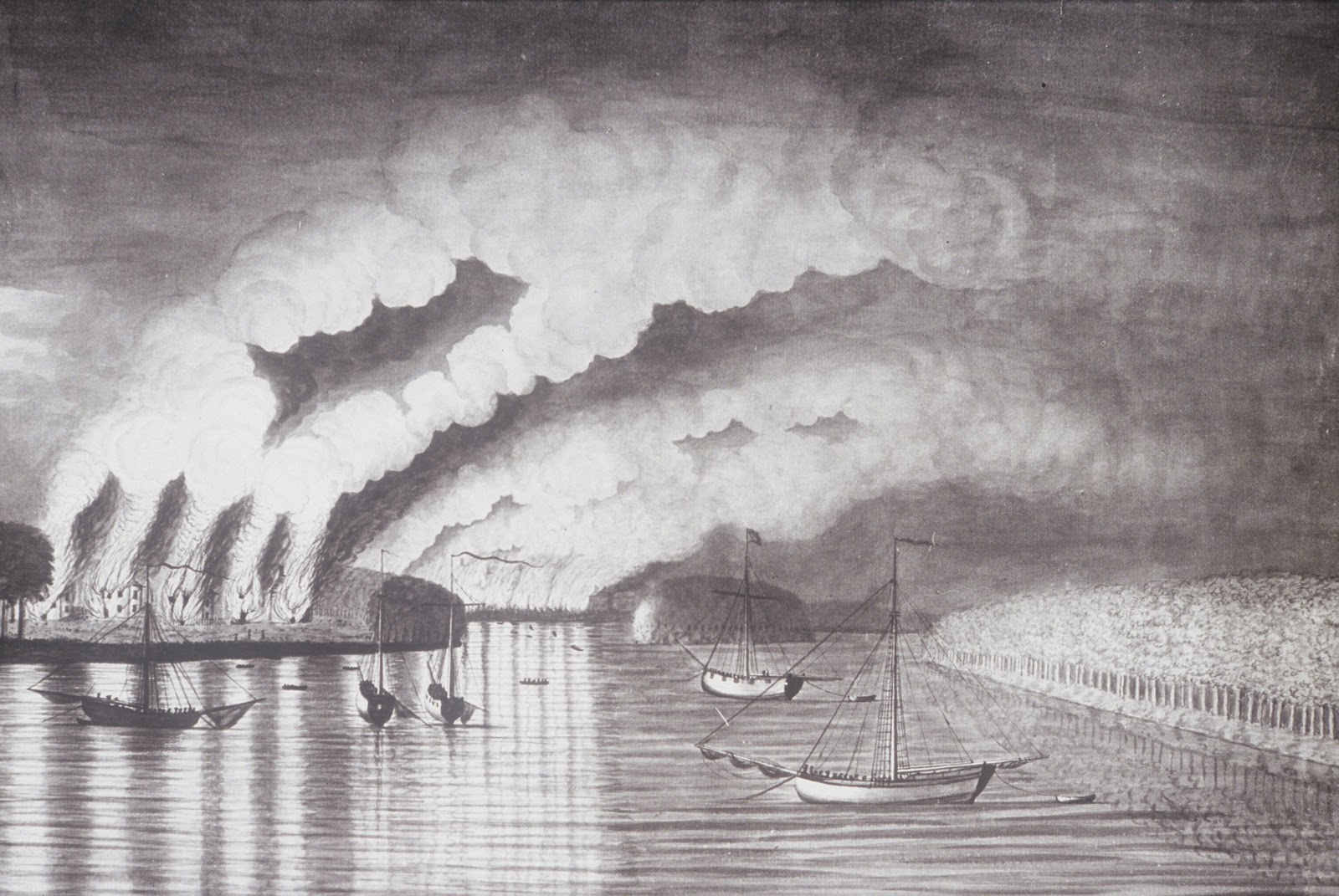
St. John River Campaign: Raid on Grimrose (present day Gagetown, New Brunswick). This is the only contemporaneous image of the Expulsion of the Acadians

It was with a heavy heart that I found an article with irrefutable proof about the sentiments regarding my paternal line's history, while web-surfing the other day. I have written to you, dear readers, somewhat about my mixed and varied ancestry, but never about the scar it has left upon my family's psyche. We hear about the Jewish horrors from World War II, and in graphic detail about slavery and prejudice towards African-Americans, both great evils to be sure. Are there not other stories to be told? I seek to address this imbalance by finally sharing with you some commonly held perceptions about French-Canadians. 

The link to the article below, about the nasty French-Canadian influence upon delicate New England sensibilities, appeared in The New York Times from 1892, a scant 118 years ago, long after many societal injustices in this country had already been addressed and corrected. These prejudices still ring true today (I have had the unfortunate experience to hear them expressed to me, directly to my face), if you are lucky enough to encounter someone with these roots, given the extermination efforts directed against us.

My mother has a recollection from a trip we took to Nova Scotia from Maine, across the Bay of Fundy via ferry. It is a Canadian Maritime Province and an island with Acadian roots, for those of us with Huguenot ancestry. We attended Sunday service in Woodland, ME, before leaving for Canada. She said the priest delivered an entreating homily to the parishioners about how "we should treat these poor French-Canadians with 'Christian Charity', since they are people, too". No wonder my father never learned French, and staunchly characterizes himself in a jingoistic fashion as "American!" first and foremost in his loudest, firmest tone, like someone in fear of a McCarthy backlash. I asked him how we could have been separated out from other Canadian people. He replied: "Because we were darker", a slur about the common inter-marriages that existed between French descendants and Native Americans. The year of our family trip to Halifax was 1980.*

When I transferred colleges to attend the Rhode Island School of Design, I made quick friends with another student not fitting into the Ivory Tower school system, who is of Armenian heritage. As I recounted my unique history to him, it triggered the memory of high school history. What a detour that class took, because one brave girl had the courage to speak out to share her family's emigration story! My classmate grew serious, as he then told me his truth: "You are the first 'white' person I've ever met who knows about the Armenian massacre", thereby creating his own divisional line between he and I. The year was 1990.**

We, as humankind, have these histories in common, hard as that may be to accept. The next time you talk with someone, thinking that you know who they are, think again. And for G-ds' sake, ask questions. Please, please keep reading and learning. 

Knowledge and information build more bridges than fear can burn.